Welcome to the Afibber’s Forum
Serving Afibbers worldwide since 1999
Moderated by Shannon and Carey
 |
 |
 |
 |
 |
 |
|
Eliquis or Not? February 20, 2026 07:48PM |
Registered: 14 years ago Posts: 12 |
Hello -
I am an 79-year old male with a history of proximal atrial fibrillation (1994-2017), but without ANY occurrences over the last nine years.
I had determined what my triggers were and managed accordingly...
My CHA2DS2-VASc score is (2) for being over 75 years of age.
This week my NEW cardiologist/ EP recommended and prescribed a DOAC (Eliquis) 5mg twice daily.
When I asked why, she said it was fundamentally because of my prior afib history and age...
My question is: Would it be indicated that ANY 80-year old man be put on a DOAC (Eliquis) to lower the risk of stroke?
Thank You,
Jack
I am an 79-year old male with a history of proximal atrial fibrillation (1994-2017), but without ANY occurrences over the last nine years.
I had determined what my triggers were and managed accordingly...
My CHA2DS2-VASc score is (2) for being over 75 years of age.
This week my NEW cardiologist/ EP recommended and prescribed a DOAC (Eliquis) 5mg twice daily.
When I asked why, she said it was fundamentally because of my prior afib history and age...
My question is: Would it be indicated that ANY 80-year old man be put on a DOAC (Eliquis) to lower the risk of stroke?
Thank You,
Jack
|
Re: Eliquis or Not? February 20, 2026 11:42PM |
Admin Registered: 9 years ago Posts: 6,218 |
Quote
JackC
My question is: Would it be indicated that ANY 80-year old man be put on a DOAC (Eliquis) to lower the risk of stroke?
Yes, absolutely. Plenty of people 80+ are on anticoagulants.
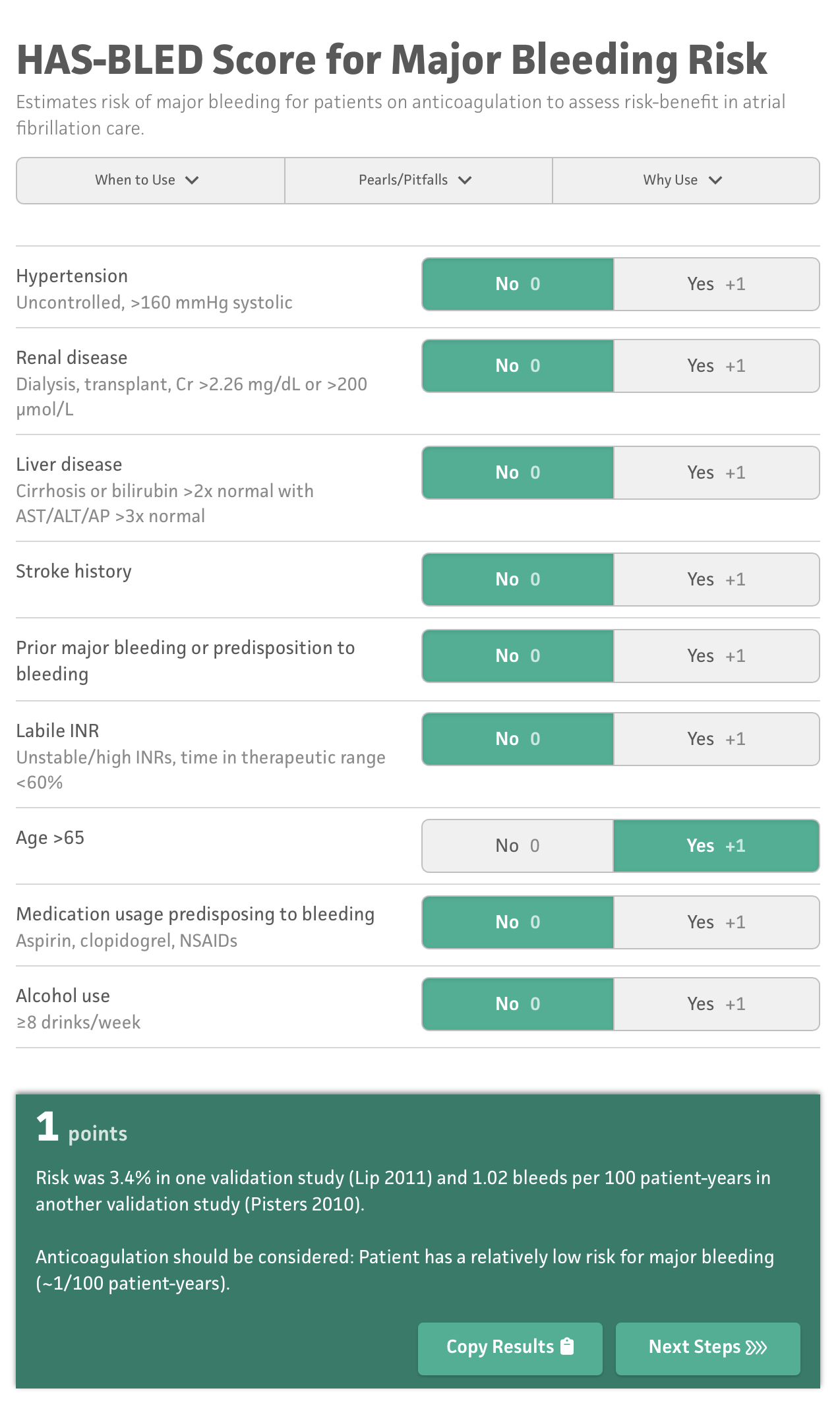
That said, I think putting someone who's a CHADS 2 and hasn't experienced an afib episode for 9 years is overly aggressive. That doesn't seem to me to be a good risk/benefit balance. You should calculate your HAS-BLED score too. That will clarify your bleeding risk.
|
Re: Eliquis or Not? February 21, 2026 12:59AM |
Registered: 14 years ago Posts: 12 |
Thanks, Carey!🙂
My HAS-BLED score is (1), which I suppose makes me a prime candidate for anticoagulants.
Would you agree?
For the record, I consume just about every natural food/ supplement that promotes blood thinning.
What are your thoughts regarding blood viscosity testing and platelet aggregation testing be considered before prescribing anticoagulants?
My HAS-BLED score is (1), which I suppose makes me a prime candidate for anticoagulants.
Would you agree?
For the record, I consume just about every natural food/ supplement that promotes blood thinning.
What are your thoughts regarding blood viscosity testing and platelet aggregation testing be considered before prescribing anticoagulants?

|
Re: Eliquis or Not? February 21, 2026 03:53AM |
Admin Registered: 9 years ago Posts: 6,218 |
I've not seen any convincing evidence that things like viscosity and aggregate testing are worthwhile. Want more viscous blood? Simple, drink more water.
If I were in your shoes, I would agree to half-dose Eliquis, but not full dose. That's what I take now and I even have a Watchman device that protects me from 90% of clot risks, but I view it as insurance against the other 10%.
If I were in your shoes, I would agree to half-dose Eliquis, but not full dose. That's what I take now and I even have a Watchman device that protects me from 90% of clot risks, but I view it as insurance against the other 10%.
|
Re: Eliquis or Not? February 21, 2026 04:02AM |
Registered: 14 years ago Posts: 12 |
|
Re: Eliquis or Not? February 21, 2026 09:27PM |
Registered: 8 years ago Posts: 443 |
Would it be indicated that ANY 80-year old man be put on a DOAC (Eliquis) to lower the risk of stroke?
Not simply because of age, no. The CHA2DS2-VASc score is specific only to those who have AF.
And because of that, your new EP is recommending Eliquis per guidelines, since your score is 2.
That said, many EPs are now going beyond the guidelines and taking into consideration other factors, primarily AF burden. For example, OCEAN-AF argues that the risks of AC's outweigh the benefits if you've been free of AF for one year post-ablation.
Now, you haven't had an ablation, but your 9-year freedom of AF speaks strongly. Personally, my score is CHADS 4, 2 points, which are from age, like with yourself. Based on OCEAN and other papers, two EPs advised me not to take ACs.
Jim
Not simply because of age, no. The CHA2DS2-VASc score is specific only to those who have AF.
And because of that, your new EP is recommending Eliquis per guidelines, since your score is 2.
That said, many EPs are now going beyond the guidelines and taking into consideration other factors, primarily AF burden. For example, OCEAN-AF argues that the risks of AC's outweigh the benefits if you've been free of AF for one year post-ablation.
Now, you haven't had an ablation, but your 9-year freedom of AF speaks strongly. Personally, my score is CHADS 4, 2 points, which are from age, like with yourself. Based on OCEAN and other papers, two EPs advised me not to take ACs.
Jim
|
Re: Eliquis or Not? February 23, 2026 04:15PM |
Registered: 7 years ago Posts: 62 |
|
Re: Eliquis or Not? February 23, 2026 09:29PM |
Registered: 8 years ago Posts: 443 |
Another option is a PIP approach for DOAC.
That was my strategy, following a modified version of the REACT-AF protocol. I modified the cut-off from one hour to ten hours, to give me time to convert either naturally or with Flecainide. And since trial participants are only required to wear the Apple Watch 14 hours out of 24, while a ten-hour cut-off doesn't follow the trial literally, it does in principle.
It must be noted, however, that results will not be in for several years, so anyone following that protocol is betting that the PIP group is at least non-inferior regarding strokes than the continuously coagulated group. Therefore, it makes more sense for those who are already leaning toward not taking daily anticoagulation anyway.
While the trial is new, keep in mind that a form of PIP anticoagulation has been used for years, with EPs often recommending several weeks of anticoagulation after an AF episode for those not on them on a daily basis.
Jim
Edited 2 time(s). Last edit at 02/23/2026 09:45PM by mjamesone.
That was my strategy, following a modified version of the REACT-AF protocol. I modified the cut-off from one hour to ten hours, to give me time to convert either naturally or with Flecainide. And since trial participants are only required to wear the Apple Watch 14 hours out of 24, while a ten-hour cut-off doesn't follow the trial literally, it does in principle.
It must be noted, however, that results will not be in for several years, so anyone following that protocol is betting that the PIP group is at least non-inferior regarding strokes than the continuously coagulated group. Therefore, it makes more sense for those who are already leaning toward not taking daily anticoagulation anyway.
While the trial is new, keep in mind that a form of PIP anticoagulation has been used for years, with EPs often recommending several weeks of anticoagulation after an AF episode for those not on them on a daily basis.
Jim
Edited 2 time(s). Last edit at 02/23/2026 09:45PM by mjamesone.
|
Re: Eliquis or Not? February 24, 2026 03:26AM |
Registered: 9 years ago Posts: 72 |
I have PIP Eliquis as well. I have worked to identify triggers and have reduced episodes to 15 minutes, once or twice a year. I am female and turn 75 this year so my score goes up. I requested to take a half dose if I ever need one, since I weigh 104 and have kidney disease. Once I reach 80 they will recommend half dose. My EP says my current burden does not warrant anticoagulation. Nine years afib free would seem to argue risk from the meds is greater than risk of stroke, but the study on PIP isn't done I guess. My EP leaves me some discretion. No sliding scale for time in afib and time on Eliquis!
|
Re: Eliquis or Not? February 25, 2026 08:13AM |
Registered: 12 years ago Posts: 1,154 |
"This week my NEW cardiologist/ EP recommended and prescribed a DOAC (Eliquis) 5mg twice daily.
When I asked why, she said it was fundamentally because of my prior afib history and age"
At nine years free of AFIB, my opinion is that the history of AFIB shouldn't be much of a factor. If your AFIB returns, then add that in to the equation of your decision.
When I asked why, she said it was fundamentally because of my prior afib history and age"
At nine years free of AFIB, my opinion is that the history of AFIB shouldn't be much of a factor. If your AFIB returns, then add that in to the equation of your decision.
|
Re: Eliquis or Not? February 27, 2026 02:36PM |
Registered: 4 years ago Posts: 236 |
I had the surgical ablation of my AA many years ago during a Mini Maze clinical trial. 19 years ago. For years Cardiologists and EP have had a running discourse on should I be on a AC. More recently I was told by my EP you have options: take nothing, take low dose aspirin a few times a week, take a low dose AC. Last CT indicated it was still closed and no leaks. Had a great surgeon.
What is the point of having a closure device or the surgical ablation if you have to stay on a AC for life? I was advised to keep a PIP in case I have an afib recurrence. For some folks, this comes down to personal choice. Interesting note: I have had AFIB since age 30. back then only AC was Warfarin, which was not prescribed for me - this was also pre ablation availability days and few drug choices. I am 76. Makes you wonder if it was luck or providence that I did not have a stroke back then.
What is the point of having a closure device or the surgical ablation if you have to stay on a AC for life? I was advised to keep a PIP in case I have an afib recurrence. For some folks, this comes down to personal choice. Interesting note: I have had AFIB since age 30. back then only AC was Warfarin, which was not prescribed for me - this was also pre ablation availability days and few drug choices. I am 76. Makes you wonder if it was luck or providence that I did not have a stroke back then.
|
Re: Eliquis or Not? February 27, 2026 04:56PM |
Registered: 8 years ago Posts: 443 |
What is the point of having a closure device or the surgical ablation if you have to stay on a AC for life?
I'm assuming your LAA was sutured closed back then, or do you know if they used a clip or another device? In any case, closure during a surgical ablation is generally more complete and durable than with catheter-based devices like Watchman, which typically require low-dose aspirin for life. And along that line of thinking, many, if not most patients in the mini-maze community, rely on the closure itself and do not anticoagulate.
So, yes, you have those choices, but from my point of view, taking ACs, or even baby aspirin, would be belt-and-suspenders for stroke risk, with the trade off a higher bleed risk. The other reason to have a surgical ablation is that they tend to be more successful and durable, especially for persistent. Of course, here the trade-off is that it's a more invasive procedure up front, which makes sense for some.
Jim
I'm assuming your LAA was sutured closed back then, or do you know if they used a clip or another device? In any case, closure during a surgical ablation is generally more complete and durable than with catheter-based devices like Watchman, which typically require low-dose aspirin for life. And along that line of thinking, many, if not most patients in the mini-maze community, rely on the closure itself and do not anticoagulate.
So, yes, you have those choices, but from my point of view, taking ACs, or even baby aspirin, would be belt-and-suspenders for stroke risk, with the trade off a higher bleed risk. The other reason to have a surgical ablation is that they tend to be more successful and durable, especially for persistent. Of course, here the trade-off is that it's a more invasive procedure up front, which makes sense for some.
Jim
|
Re: Eliquis or Not? February 27, 2026 05:04PM |
Registered: 4 years ago Posts: 236 |
They used a clip and sutures. There was not a lot of information back then about durability or information about using a AC for life. I was followed up by the study for several years for both the closure success and how long the Mini Maze "fixed" Afib. More information these days. Seems like yesterday I volunteered and it has been almost 20 years.
|
Re: Eliquis or Not? February 27, 2026 05:13PM |
Registered: 8 years ago Posts: 443 |
Curious, what is your AF history and did the mini-maze hold for 19 years, or did you need any follow-up procedures? Also, regarding your lack of anticoagulation pre-ablation, I was also not offered AC back in those days, and even in the DOAC era, before my ablation, my cardiologist felt that the risk of ACs outweighed the benefits, which may have been your case.
Jim
Jim
|
Re: Eliquis or Not? February 27, 2026 10:13PM |
Registered: 4 years ago Posts: 236 |
It lasted ten years. I have had two "touch ups" since 2017. Hopefully no more in the future. I was diagnosed at age 30, and there were little options to help. I raised my hand when Emory University were looking for volunteers for the Mini Maze. Over the years I asked the question why so young? No comorbidities. I have been given various theories over the past 46 years. Genetics, virus, or just bad luck. I was on warfarin after the ablation for a few months.
|
Re: Eliquis or Not? February 27, 2026 11:35PM |
Registered: 8 years ago Posts: 443 |
I also had my first AF episode in my 30's. While uncommon, my understanding is that it's not rare. Sometimes they just don't know the reason. Same thing with a friend of mine, but he was in his 20's. My guess is that this younger group is underrepresented in many forums like this one, in part due to infrequent and/or self-limiting episodes, and also they may not frequent traditional forums like these. But they're around.
Jim
Edited 1 time(s). Last edit at 02/27/2026 11:36PM by mjamesone.
Jim
Edited 1 time(s). Last edit at 02/27/2026 11:36PM by mjamesone.
|
Re: Eliquis or Not? February 28, 2026 12:36AM |
Admin Registered: 9 years ago Posts: 6,218 |
Quote
mjamesone
devices like Watchman, which typically require low-dose aspirin for life.
Actually, that depends on whose opinion you prefer. The FDA's recommendation is aspirin for life, but there's no good evidence to support that recommendation. It's based more on a sense that they had to do something rather than any empiric data. You won't find much agreement with that recommendation outside the US. In Europe, which has a longer history with the Watchman than the US does, once the device is confirmed leak-free anticoagulants are usually stopped, even aspirin. There are a lot of EPs in the US who agree. And there are at least two studies showing that aspirin following a Watchman did not reduce embolic events but did increase bleeding events.
|
Re: Eliquis or Not? February 28, 2026 02:16AM |
Registered: 8 years ago Posts: 443 |
And there are at least two studies showing that aspirin following a Watchman did not reduce embolic events but did increase bleeding events.
Let's assume these studies are correct. That still doesn't change my broader point about the completeness and durability of surgical LAA closure versus a Watchman-type device. Leakage with Watchman is a real issue, common enough to require routine follow-up imaging and then aspirin if necessary. On the other hand, once a surgical closure is confirmed, ongoing leak management isn't typically required. That and there is no
device-related thrombus risk.
Jim
Edited 1 time(s). Last edit at 02/28/2026 02:21AM by mjamesone.
Let's assume these studies are correct. That still doesn't change my broader point about the completeness and durability of surgical LAA closure versus a Watchman-type device. Leakage with Watchman is a real issue, common enough to require routine follow-up imaging and then aspirin if necessary. On the other hand, once a surgical closure is confirmed, ongoing leak management isn't typically required. That and there is no
device-related thrombus risk.
Jim
Edited 1 time(s). Last edit at 02/28/2026 02:21AM by mjamesone.
|
Re: Eliquis or Not? February 28, 2026 03:56AM |
Admin Registered: 9 years ago Posts: 6,218 |
Oh, I'm not disagreeing with that at all. Surgical closure is almost always superior to transcatheter devices. But people who are undergoing cardiac surgery for other reasons and can elect to have their LAAs closed during the procedure are a pretty small percentage of the people who would benefit from having their LAA closed one way or another. I can't imagine undergoing surgery just to close the LAA. I wonder how many surgeons would even be willing to do that.
|
Re: Eliquis or Not? February 28, 2026 02:10PM |
Registered: 4 years ago Posts: 236 |
My husband had a catastrophic aorta dissection 3 years ago. The surgeon who saved his life told us that he closed his LAA so that he would not have to be on AC for life, He said this is now routine for any open-heart surgery. Would not recommend this avenue. He is now in and out of slow atrial flutter but has no symptoms. His EP is reluctant to "fix" the flutter particularly since his heart rate is in the 50-60 range and no symptoms. However, should that change it will be addressed. He does not take any AC because of the closure.
|
Re: Eliquis or Not? February 28, 2026 02:53PM |
Registered: 8 years ago Posts: 443 |
Quote
Carey
Oh, I'm not disagreeing with that at all. Surgical closure is almost always superior to transcatheter devices. But people who are undergoing cardiac surgery for other reasons and can elect to have their LAAs closed during the procedure are a pretty small percentage of the people who would benefit from having their LAA closed one way or another. I can't imagine undergoing surgery just to close the LAA. I wonder how many surgeons would even be willing to do that.
Was not discussing stand-alone. The reference was to OP's concern about anticoagulation after Mini-Maze.
Jim
|
Re: Eliquis or Not? March 01, 2026 07:01PM |
Registered: 6 years ago Posts: 63 |
I am also 79 yo and had a successful ablation 5 years ago and have been afib free ever since. I have been on 5mg of eliquis bid because my cardiologist has recommended this. However, there are clinical trials which are pointing to the opposite conclusion: the "Alone-Afib" trial and the "OCEAN" trial. Both of these trials concluded that remaining on anticoagulants, after a successful ablation of at least one year duration, did not reduce the incidence of stroke or systemic embolism, but it did increase the incidence of serious bleeding.
I am seriously considering stopping my Eliquis and taking a baby dose aspirin instead. This is what was used in the Ocean trial. It is a big step to take because of the consequence of stroke. However, as I get older, I am also concerned about risk of major bleeding event. My CHA2DS2-VASc Score is 3. 2 points for my age and 1 point for hypertension which is well controlled on losartan. Unfortunately, there are no guarantees with either strategy Perhaps additional clinical trials will make the choice a little clearer.
I am leaning toward baby aspirin because I also have a high LP little a which is a high risk factor for plaque buildup in arteries leading to stroke and heart attack. Studies have shown some benefit of aspirin in reducing events in people with LP a.
I am seriously considering stopping my Eliquis and taking a baby dose aspirin instead. This is what was used in the Ocean trial. It is a big step to take because of the consequence of stroke. However, as I get older, I am also concerned about risk of major bleeding event. My CHA2DS2-VASc Score is 3. 2 points for my age and 1 point for hypertension which is well controlled on losartan. Unfortunately, there are no guarantees with either strategy Perhaps additional clinical trials will make the choice a little clearer.
I am leaning toward baby aspirin because I also have a high LP little a which is a high risk factor for plaque buildup in arteries leading to stroke and heart attack. Studies have shown some benefit of aspirin in reducing events in people with LP a.
|
Re: Eliquis or Not? March 01, 2026 09:28PM |
Registered: 8 years ago Posts: 443 |
Yes, two important trials. And I think we’re on the same page here, but to clarify, the OCEAN trial did not point to low-dose aspirin (LDA) over anticoagulation, it pointed toward taking neither if you were AF free for one year post-ablation.
But before starting on LDA for potential heart issues, given your high lp(a), you might consider further stratifying your cardiac risk with some imaging, such as a CT CAC Score, or better yet, a CT Angiogram (CCTA). Not just because you may not need LDA, which is not without risks, but because if you do have any blockages, you can treat them even more aggressively than just LDA.
In my case, I waited too long for imaging and ended up with a diagnosis of severe five-vessel CAD requiring six stents. Had I had imaging earlier, that all may have been averted. Like yourself, I also have high lp(a). And FWIW I also had recently passed a nuclear stress test, which gave both my doctors and me a false sense of security, when in fact the result was a false negative, which is not uncommon.
I understand that many cardiologists may push back on imaging if you're asymptomatic, but the more proactive ones are using it now, especially with someone your age and with a high lp(a).
Jim
But before starting on LDA for potential heart issues, given your high lp(a), you might consider further stratifying your cardiac risk with some imaging, such as a CT CAC Score, or better yet, a CT Angiogram (CCTA). Not just because you may not need LDA, which is not without risks, but because if you do have any blockages, you can treat them even more aggressively than just LDA.
In my case, I waited too long for imaging and ended up with a diagnosis of severe five-vessel CAD requiring six stents. Had I had imaging earlier, that all may have been averted. Like yourself, I also have high lp(a). And FWIW I also had recently passed a nuclear stress test, which gave both my doctors and me a false sense of security, when in fact the result was a false negative, which is not uncommon.
I understand that many cardiologists may push back on imaging if you're asymptomatic, but the more proactive ones are using it now, especially with someone your age and with a high lp(a).
Jim
|
Re: Eliquis or Not? March 02, 2026 03:57AM |
Registered: 6 years ago Posts: 63 |
Jim, thank you for your reply to my post. I did get a CT cardiac calcium score as well as a CT scan of my carotid arteries. I do have plaque, but not excessive for my age. As you know, there's not too much at this point to do about LP [a] other than lowering all your other risk factors by following a healthy lifestyle. At one point I did manage to lower my LP [a] by 1/3 following the "portfolio diet".
I am on a low-dose statin [Crestor] that I take every other day. I try to get my LDL under 100 and as low as possible. If you have any other ideas of how to minimize risk, please let me know. I am not aware of any support forums for LP [a] like this one for afib. If you know of any, please let me know as I find it very helpful to communicate with others who are struggling with similar issues.
Regards, Frank.
I am on a low-dose statin [Crestor] that I take every other day. I try to get my LDL under 100 and as low as possible. If you have any other ideas of how to minimize risk, please let me know. I am not aware of any support forums for LP [a] like this one for afib. If you know of any, please let me know as I find it very helpful to communicate with others who are struggling with similar issues.
Regards, Frank.
|
Re: Eliquis or Not? March 02, 2026 05:39PM |
Registered: 8 years ago Posts: 443 |
If you have any other ideas how to minimize (cardiac) risk...
What to do isn’t cookie-cutter, and even among good cardiologists, opinions differ in terms of how aggressive to monitor and treat.
In your case, determining factors would include your exact CAC score and ultrasound results, family history, symptoms (if any), and how aggressively you want to both monitor and treat.
Personally, I started as a medical conservative in terms of both monitoring and treatment, and looking back, I should have been more proactive.
Here are some options, not necessarily recommendations, some of which are part of what is termed Optimal Medical Therapy (OMT). You might want to study up on any of what you are unfamiliar with and decide which might be relevant.
1. Lower LDL target. That would mean a higher-dose statin, possibly ezetimibe or a PCSK9 inhibitor like the injectable, Repatha. The advantage of stronger statins is not just to drive LDL lower, but also reduce systemic inflammation. The LDL lowering synergy can be quite powerful. With the combination of 40mg Crestor and Repatha, my LDL is 18, which is where my cardiologist wants it. PCSK9 inhibitors can also have a modest (up to 30 per cent) improvement with Lp(a).
2. Add low-dose aspirin and an ACE or ARB as part of OMT, depending on your overall risk profile and blood pressure control.
3. Monitor anti-inflammatory markers such as hs-CRP and use it as another metric to guide treatment.
4. Consider further imaging, such as a CCTA, which will show soft plaque that a CAC scan can miss. Depending on the results, combine with AI HeartFlow analysis. While some cardiologists might think this is too aggressive without symptoms, my brother, who has a similar profile to yours, had this done recently at Mayo. The scan showed moderate to severe soft plaque, fortunately, with good flow. He was recommended a more aggressive medical plan, including high-dose statins and low-dose aspirin.
5. Enroll in a lp(a) trial and/or keep watch on the phase 3 Lp(a)HORIZON trial. Results should be first half of this year. They have already established that Lp(a) can be dramatically lowered by the study drug. But this trial answers the important question of how much the lowering translates into a reduction of CAD.
6. Find a good proactive cardiologist/lipidomiologist to work with. One who believes in shared medical decision making. Then participate and help direct your own tx as much as you feel confident.
Jim
What to do isn’t cookie-cutter, and even among good cardiologists, opinions differ in terms of how aggressive to monitor and treat.
In your case, determining factors would include your exact CAC score and ultrasound results, family history, symptoms (if any), and how aggressively you want to both monitor and treat.
Personally, I started as a medical conservative in terms of both monitoring and treatment, and looking back, I should have been more proactive.
Here are some options, not necessarily recommendations, some of which are part of what is termed Optimal Medical Therapy (OMT). You might want to study up on any of what you are unfamiliar with and decide which might be relevant.
1. Lower LDL target. That would mean a higher-dose statin, possibly ezetimibe or a PCSK9 inhibitor like the injectable, Repatha. The advantage of stronger statins is not just to drive LDL lower, but also reduce systemic inflammation. The LDL lowering synergy can be quite powerful. With the combination of 40mg Crestor and Repatha, my LDL is 18, which is where my cardiologist wants it. PCSK9 inhibitors can also have a modest (up to 30 per cent) improvement with Lp(a).
2. Add low-dose aspirin and an ACE or ARB as part of OMT, depending on your overall risk profile and blood pressure control.
3. Monitor anti-inflammatory markers such as hs-CRP and use it as another metric to guide treatment.
4. Consider further imaging, such as a CCTA, which will show soft plaque that a CAC scan can miss. Depending on the results, combine with AI HeartFlow analysis. While some cardiologists might think this is too aggressive without symptoms, my brother, who has a similar profile to yours, had this done recently at Mayo. The scan showed moderate to severe soft plaque, fortunately, with good flow. He was recommended a more aggressive medical plan, including high-dose statins and low-dose aspirin.
5. Enroll in a lp(a) trial and/or keep watch on the phase 3 Lp(a)HORIZON trial. Results should be first half of this year. They have already established that Lp(a) can be dramatically lowered by the study drug. But this trial answers the important question of how much the lowering translates into a reduction of CAD.
6. Find a good proactive cardiologist/lipidomiologist to work with. One who believes in shared medical decision making. Then participate and help direct your own tx as much as you feel confident.
Jim
|
Re: Eliquis or Not? March 03, 2026 10:46PM |
Registered: 6 years ago Posts: 63 |
Jim,
You have managed to get your LDL radically low. I am OK with getting it in the 60s. I have thought about PCSK9 inhibitors but my (cardiologist) has discouraged this, and thinks that insurance would not cover. I like the fact that it can reduce LP [a] as well as LDL, whereas statins actually raise lp [a] a bit. Actually, I am not happy with my (cardiologist) as he is somewhat lackadaisical. I'm currently looking for one who is a bit more proactive. Thanks again for sharing and the best of luck to you.
You have managed to get your LDL radically low. I am OK with getting it in the 60s. I have thought about PCSK9 inhibitors but my (cardiologist) has discouraged this, and thinks that insurance would not cover. I like the fact that it can reduce LP [a] as well as LDL, whereas statins actually raise lp [a] a bit. Actually, I am not happy with my (cardiologist) as he is somewhat lackadaisical. I'm currently looking for one who is a bit more proactive. Thanks again for sharing and the best of luck to you.
|
Re: Eliquis or Not? March 30, 2026 02:26AM |
Registered: 5 months ago Posts: 7 |
|
Re: Eliquis or Not? May 06, 2026 10:01PM |
Registered: 4 years ago Posts: 38 |
Most of the statistics regarding the watchman are clearly arbitrary. For whatever reason, in the USA, it was determined that leaks up to 5mm could be ignored. Europe, being socialists used a more conservative 3mm limit. Most top EP’S will now tell you than the tolerance is zero leaks, which makes perfect sense and why I cancelled a watchman several years ago. All current LAAO devices are metal and thus can be pro thrombotic, hence the lifetime of aspirin, even with the coated watchman. The amulet, while a better seal due to being a double seal, also leaves exposed metal which can cause a clot. Boston scientific is now testing a fourth generation device which is supposed to be flexible, but I wouldn’t bet it results in no leaks. You’re putting a round plug into an irregular hole. Moreover, leaks can and do develop years after the procedure, which puts you back on anticoagulation, but now with a metal plug permanently in your heart. Even epicardial devices such as the atriclip, can and do bend and move, causing leaks. Plus, the LAA is responsible for producing hormones and I do not believe medicine understands the effects of that. And since ablating the LAA is more difficult after a LAAO, the more aggressive EP’S like to ablate the LAA along with implanting a watchman. An isolated LAA does not pump and allows clots to escape. As for whether a watchman is non-inferior to OAC, that is meaningless. The manufacturer picks a CI, so the watchman can lead to more strokes and still be non-inferior statistically but not clinically. If you ask me, these devices are not ready for prime time.
|
Re: Eliquis or Not? May 09, 2026 05:13PM |
Registered: 8 years ago Posts: 443 |
Yes, an LDL target under 70, or being more proactive, under 50, might make sense. That would mean upping your Crestor to probably 20-40mg/day. Or if that didn't get you there, or you don't want to increase your statin dose, you could stay at the current dose and mix in Ezetimibe, or alternatively, a lower dose PCKS9 inhibitor, such as 75mg Praluent.
Your cardiologist seems typical and conservative, like mine was. After my diagnosis of CAD, which came out of left field, I left him and am now on a more aggressive course.. You're not where I'm at, so you don't need my meds and LDL target, but on the other hand, you don't want to get where I'm at.
Jim
Your cardiologist seems typical and conservative, like mine was. After my diagnosis of CAD, which came out of left field, I left him and am now on a more aggressive course.. You're not where I'm at, so you don't need my meds and LDL target, but on the other hand, you don't want to get where I'm at.
Jim
Sorry, only registered users may post in this forum.