Welcome to the Afibber’s Forum
Serving Afibbers worldwide since 1999
Moderated by Shannon and Carey
 |
 |
 |
 |
 |
 |

Home
>
AFIBBERS FORUM
>
Topic
Afib alert in sleep everyday , no symptoms
Posted by kumartx
|
Afib alert in sleep everyday , no symptoms January 25, 2025 02:44AM |
Registered: 1 year ago Posts: 1 |
Hi All
Just found this form in my google searches to find more information on Afib.
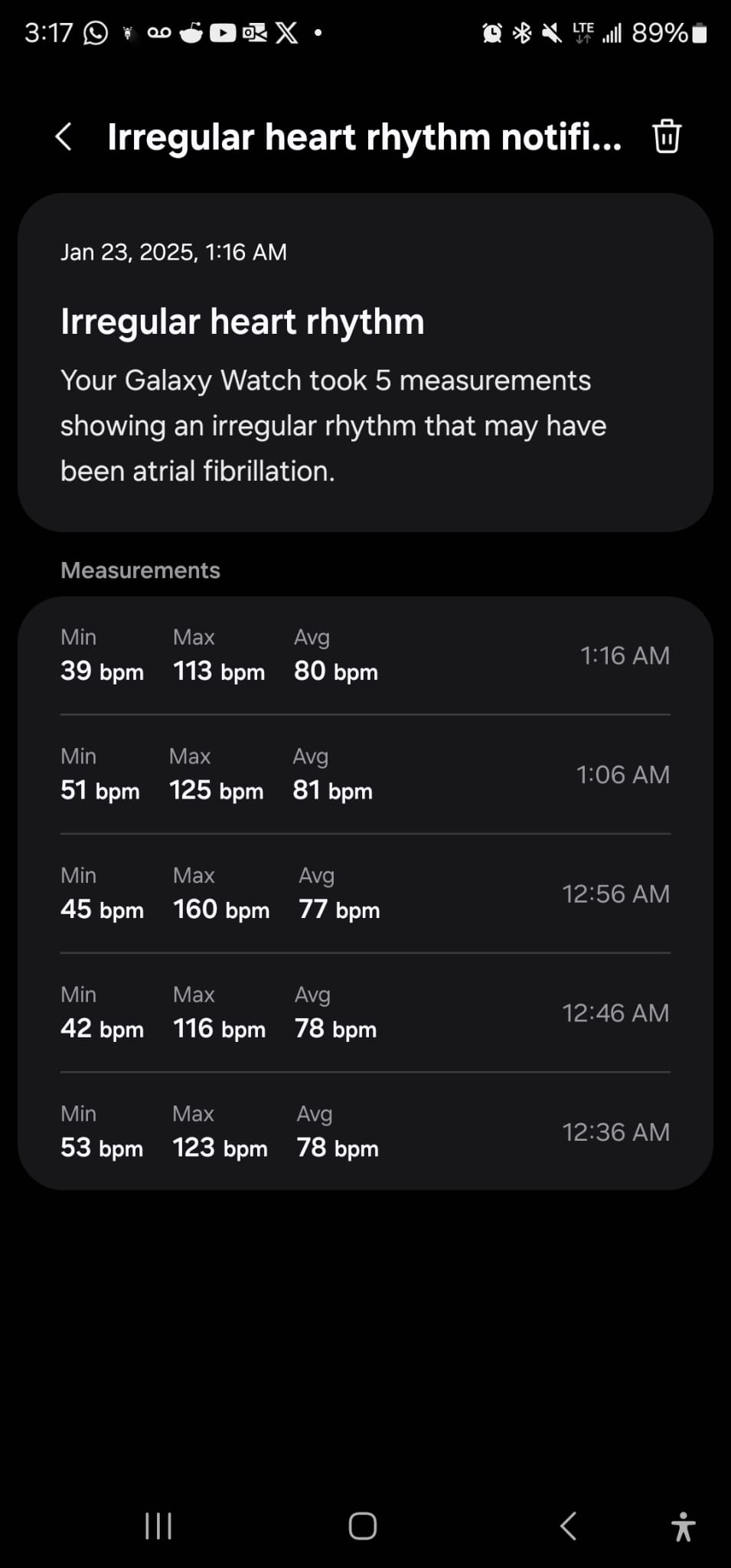
Few weeks ago i went to vacation to India and got a routin ECG and they said i got some signs of Afib. On my return back to US and bought a smart ( samsung galaxy ) watch which for past couple of weeks every day shows 1 alert with 5 readings saying it detected irregular heart beat. I do not feel any of the typical afib symptoms ( palpitations, flutter, fatigue etc) and usually have atleast 6 hours solid sleep. I had 1 initial appointment with cardiologist and they ordered a Holter monitor ( yet to get results) but gave me a Carvedilol 3.5mg and asked to have low dose apsrin everyday in mean while. I am skeptic about these medications and want to know your thoughts on accuracy of the watch. During the day i dont get any irregular heart beat alert from the watch but every night i seem to get 1 ( and few nights two). I also did a CA calcisum socre test and got 350 , now it is directly not related to afib ( from what i understand)..but it added to my worry. I am male in early 40's and BMI 23 . My next appointment is in 3 weeks with the doc , but i have doubts should i be on blood thinners instead of baby asprin, is the cavedilol dosage less or more etc kind of questions bothering.. Any advice on what should be next steps and if CAC score has any relation to AFIB ( my LDL is 55) ..what remedies should i take. I would like to avoid any invasive procedures if there is an option for few years. Love to hear any comments/suggestions
Just found this form in my google searches to find more information on Afib.
Few weeks ago i went to vacation to India and got a routin ECG and they said i got some signs of Afib. On my return back to US and bought a smart ( samsung galaxy ) watch which for past couple of weeks every day shows 1 alert with 5 readings saying it detected irregular heart beat. I do not feel any of the typical afib symptoms ( palpitations, flutter, fatigue etc) and usually have atleast 6 hours solid sleep. I had 1 initial appointment with cardiologist and they ordered a Holter monitor ( yet to get results) but gave me a Carvedilol 3.5mg and asked to have low dose apsrin everyday in mean while. I am skeptic about these medications and want to know your thoughts on accuracy of the watch. During the day i dont get any irregular heart beat alert from the watch but every night i seem to get 1 ( and few nights two). I also did a CA calcisum socre test and got 350
, now it is directly not related to afib ( from what i understand)..but it added to my worry. I am male in early 40's and BMI 23 . My next appointment is in 3 weeks with the doc , but i have doubts should i be on blood thinners instead of baby asprin, is the cavedilol dosage less or more etc kind of questions bothering.. Any advice on what should be next steps and if CAC score has any relation to AFIB ( my LDL is 55) ..what remedies should i take. I would like to avoid any invasive procedures if there is an option for few years. Love to hear any comments/suggestions
|
Re: Afib alert in sleep everyday , no symptoms January 25, 2025 04:44PM |
Registered: 8 years ago Posts: 942 |
|
Re: Afib alert in sleep everyday , no symptoms January 25, 2025 07:19PM |
Registered: 4 years ago Posts: 1,340 |
I had an ablation that failed inside of a week. Months passed after the blanking period and a Holter that showed a lot of PACs, and then at the four month mark I got a nasty shot of AF. I took an ECG with my Galaxy watch and sent it off to the EP. He didn't question it, and agreed to try again. So some physicians accept the reading from a wearable, particularly if he/she knows the patient and the readout shows unmistakable/typical variation in R-R interval and no apparent P waves...which mine readily depicted.
My AF was only active during the day (thank the Good Lord!!). If I went to bed with a grumpy HR rhythm, it would settle down by the time I turned over to drift off, and as far as I know, I was AF-free all night. Didn't awaken a single time, ever, feeling the familiar thumping. My sister-in-law is one of many sufferers who find their AF most active during bed rest. How awful!!
Your calcium score isn't a great one, sorry, especially at your age, but it's only a snapshot of existing calcium deposition. It doesn't show the directionality, only what is extant. However, the chances are pretty good that you're headed in the wrong direction. Unless your genetics are at at fault, it might be lifestyle, which you can modify. If genetic, you'll need a medical intervention, probably a statin.
Yes, AF can be brought on by ischemia. At least, that's what my cardiologist feared when I first presented, and he had me submit to all sorts of tests, none of which indicated ischemia. I requested a Doppler ultrasound of my carotid arteries, which my GP agreed to, and the results were rather good for a then-67 year-old male. The cardio also put me on a statin feeling that my lipid panel wasn't great....but how to explain my clear arteriies, is what I asked. Shrug. Take the statin, m'kay?
One major contributor to plaque deposition is inflammation. You may need a CRP test, or an ESR and if it's above 'normal' range, there's something your body doesn't like.
|
Re: Afib alert in sleep everyday , no symptoms January 25, 2025 09:30PM |
Admin Registered: 9 years ago Posts: 6,255 |
|
Re: Afib alert in sleep everyday , no symptoms January 25, 2025 09:50PM |
Admin Registered: 13 years ago Posts: 4,706 |
Quote
kumartx
Love to hear any comments/suggestions
My doc friends tell me that patients of east asian descent, genetically (don't know if that includes you), are not as prone to have a lot of subcutaneous fat. Hence they can be "skinny fat.' Meaning they are of relatively low BMI, but can have a material amount of fat around their organs (called called visceral fat). They like for these patients to have a max BMI of 22.9. See here.
Sometimes those with a higher BMI can have high triglyceride levels as well. Ideally what is known as "Kraft Test" could be performed. This is a form of an oral glucose tolerance test that has insulin sampled at the same time as serum glucose. Though the parameters could change a bit, basically you are first fasting at least 12 hours, then glucose and insulin are sampled. Then you consume 75 grams of glucose and your glucose and insulin are measured at 30, 60, 120 and 240 minutes (times are from my memory and may be off a bit, but usually 5 samples. These are then analyzed to for the patterns of insulin production. Here is a redraft of Dr. Kraft's original paper from 1975 (Dr. Kraft passed in his mid to late 90's around 2017 or 18). Meridian Valley is one lab that will perform this test, here's a [url=https://www.meridianvalleylab.com Kraft test]search[/url].
A lot of times hyperinsulinemia can be one cause of cardiovascular disease. Hence my emphasis on the Kraft test. Not a lot of docs prescribe the test, but it is a great indicator of metabolic health, in my opinion.
Dr. Kraft wrote a [url=https://www.amazon.com/Health-Fitness-Dieting-Joseph-KRAFT-Books/s?rh=n%3A10%2Cp_27%3AJoseph%2BKRAFT]book[/url] on this.
Here is an [url=https://www.youtube.com/watch?v=w0nV-_ddXoc]interview[/url] with Dr. Kraft.
Sorry, only registered users may post in this forum.
Parse error: syntax error, unexpected token "{" in /services/webpages/a/f/afibbers.org/public/forum/mods/spamhurdles/api.php on line 694