Welcome to the Afibber’s Forum
Serving Afibbers worldwide since 1999
Moderated by Shannon and Carey
 |
 |
 |
 |
 |
 |
|
Accuracy of Kardia Mobile?? Frustrated! October 27, 2024 05:03PM |
Registered: 7 years ago Posts: 26 |
Hello fellow A-fibers:
I've been using Kardia Mobile for 6 years to detect my asymptomatic Persistent A-Fib (74 years old). Each time I get it corrected with cardioversion which lasts 9-12 months between episodes. A month ago, I went A-fib and had the usual cardioversion. However, this time I went back into A-fib in one week; confirmed by EKG machine in Dr office. So now I'm waiting for my next Dr appoint to discuss Ablation. However, this time something unusual is happening. Over the past week when I do my Karida after waking up each day it shows Normal Sinus Rhythm. Then an hour later it gives the Possible A-fib message. More readings during the day confirm A-fib again. Now as the week goes on, I am getting more and more Normal Sinus readings and less Possible A-fib readings. The trend seems to be reversing towards the better. As a side note I must add that a few days before cardioversion and days after, I was on Cipro for an infection. My Primary Dr suggested I not do cardioversion until after I stopped it but my cardiologist said the Cipro was not a problem and to proceed with cardioversion. So now I have a ton of questions:
1) Is it possible for someone to convert from Persistent A-fib to Paroxysmal A-fib, thereby giving the conflicting Kadria Mobile results?
2) Since the Kardia Mobile results are trending towards more Normal SR than Possible A-Fib, could that be the result of the Cipro wearing off?
3) Is the Kardia Mobile accurate? Are there any known issues of it giving false positives or false negatives. At times it gives "Unclassified". What the heck is that about?
I need answers to these questions before considering Ablation and will certainly ask my Cardiologist. Was wondering what this group thought about them and is there anything else I should ask my Dr.
Feedback much appreciated.
Thank you very much!
I've been using Kardia Mobile for 6 years to detect my asymptomatic Persistent A-Fib (74 years old). Each time I get it corrected with cardioversion which lasts 9-12 months between episodes. A month ago, I went A-fib and had the usual cardioversion. However, this time I went back into A-fib in one week; confirmed by EKG machine in Dr office. So now I'm waiting for my next Dr appoint to discuss Ablation. However, this time something unusual is happening. Over the past week when I do my Karida after waking up each day it shows Normal Sinus Rhythm. Then an hour later it gives the Possible A-fib message. More readings during the day confirm A-fib again. Now as the week goes on, I am getting more and more Normal Sinus readings and less Possible A-fib readings. The trend seems to be reversing towards the better. As a side note I must add that a few days before cardioversion and days after, I was on Cipro for an infection. My Primary Dr suggested I not do cardioversion until after I stopped it but my cardiologist said the Cipro was not a problem and to proceed with cardioversion. So now I have a ton of questions:
1) Is it possible for someone to convert from Persistent A-fib to Paroxysmal A-fib, thereby giving the conflicting Kadria Mobile results?
2) Since the Kardia Mobile results are trending towards more Normal SR than Possible A-Fib, could that be the result of the Cipro wearing off?
3) Is the Kardia Mobile accurate? Are there any known issues of it giving false positives or false negatives. At times it gives "Unclassified". What the heck is that about?
I need answers to these questions before considering Ablation and will certainly ask my Cardiologist. Was wondering what this group thought about them and is there anything else I should ask my Dr.
Feedback much appreciated.
Thank you very much!
|
Re: Accuracy of Kardia Mobile?? Frustrated! October 27, 2024 08:16PM |
Admin Registered: 9 years ago Posts: 6,247 |
Quote
Myticker
1) Is it possible for someone to convert from Persistent A-fib to Paroxysmal A-fib, thereby giving the conflicting Kadria Mobile results?
2) Since the Kardia Mobile results are trending towards more Normal SR than Possible A-Fib, could that be the result of the Cipro wearing off?
3) Is the Kardia Mobile accurate? Are there any known issues of it giving false positives or false negatives. At times it gives "Unclassified". What
1) Yes, but it's extremely unusual. The trouble is, what you've described isn't persistent afib. Persistent afib means you're in afib 24/7, all day every day. You already have paroxysmal afib, so it sounds like it's simply progressing to more frequent episodes. That's what paroxysmal afib typically does, and it will probably become persistent eventually without an ablation. And once it does that, it becomes much more difficult to ablate it.
2) Yes, but my guess would be the culprit is the infection, not the cipro.
3) Yes, it is accurate when used properly. And by properly I mean sitting down, the Kardia on a desk in front of you, and not talking or moving about while recording. Also, no electronics other than your phone near it. Unclassified just means there's something about the recording that isn't normal, but it doesn't fit its criteria for declaring it to be afib. You usually see that when you're experiencing ectopics, and when it's a poor recording (recording while moving or talking, for example).
If I were you, I would pursue ablation because it's unlikely to get better on its own and you really don't want it to turn into real persistent afib. Having said that, don't just stick with your current EP because you like him or he's convenient. Ask him how many afib ablations he's done. The answer you want to hear is thousands, not hundreds. Experience is everything when it comes to ablations.
|
Re: Accuracy of Kardia Mobile?? Frustrated! October 27, 2024 09:09PM |
Registered: 4 years ago Posts: 1,332 |
Not that Carey needs me riding shotgun, but I agree with everything he has posted. You're not even informally diagnosed with 'persistent' AF, and you're showing the typical variance that those of us who have paroxysmal AF experience. Months, then only a day, then a week, then another few months between bouts. But I hope you appreciate the benefit of still being in the paroxysmal stage because those are the simplest forms of AF to treat. So, when Carey says to enlist the help of a really good EP soon, he's right on the money. You want this treated soon, before it becomes more intractable or complicated for the EP (who are only human, right?). Most of us would not like to have to change drugs or to get more of the same prescribed to keep our AF controlled. Why not get mapped, have the ablation, and be done with it on the basis of probability.
|
Re: Accuracy of Kardia Mobile?? Frustrated! October 27, 2024 11:31PM |
Registered: 7 years ago Posts: 26 |
I want to thank you guys so far for your responses, good ideas. I do need to clarify question # 1 as I did not explain it clearly. I am indeed a Persistent A-fibber. I've been dealing with A-fib for 25 years. I've had over 20 cardioversions and 1 Ablation. I've had 5 different cardiologists in those 25 years due to changes in my insurance, retirement, and moving. All of them (highly recommended in my location) have diagnosed me with Persistent A-Fib. I'm also aware that sometimes it takes 2 Ablations to correct A-Fib. My A-Fib episodes last much longer than 1 or 2 hours, or weeks, and do not correct by themselves. Rx does not convert. The only success I've had covering was with cardioversion or that 1x Ablation. My A-Fib does not go in and out on its own in a day, week, or a month as folks with Paroxysmal A-fib experience.
My question #1 was not asking if it's possible to convert from Paroxysmal to Persistent A-Fib but the other way around, from Persistent to Paroxysmal. You see, in all my years using Kardia Mobile, when I go A-fib it stays there until I get the cardioversion. My question was why is Kardia now showing I'm going from A-fib to Sinus without doing anything when I'm supposed to be Persistent.
Thanks for the response re "unclassified". Even though I've used Kardia for years I will try to sit "stiller" when testing.
My question #1 was not asking if it's possible to convert from Paroxysmal to Persistent A-Fib but the other way around, from Persistent to Paroxysmal. You see, in all my years using Kardia Mobile, when I go A-fib it stays there until I get the cardioversion. My question was why is Kardia now showing I'm going from A-fib to Sinus without doing anything when I'm supposed to be Persistent.
Thanks for the response re "unclassified". Even though I've used Kardia for years I will try to sit "stiller" when testing.
|
Re: Accuracy of Kardia Mobile?? Frustrated! October 28, 2024 02:50AM |
Admin Registered: 9 years ago Posts: 6,247 |
|
Re: Accuracy of Kardia Mobile?? Frustrated! October 28, 2024 04:10AM |
Registered: 8 years ago Posts: 172 |
May have missed it…. But, the Kardia does have an “advanced” app that is subscription based and gives 6 interpretations. I don’t know if you are using the advanced app or not but it would possibly give you a bit more information or help better define the “possible” aFib. However, as the more knowledgeable posters are suggesting, a Kardia reading may be of limited help about what is really going on.
|
Re: Accuracy of Kardia Mobile?? Frustrated! October 28, 2024 11:55AM |
Registered: 7 years ago Posts: 26 |
Yes. I have gone over 30 days without converting on my own. We are convinced (me and my doctors) that historically I've definitely been Persistent. This is why I'm asking the main question - can Persistent ever change to Paroxysmal ?Quote
Carey
Okay, I'm a little confused. If your doc put a monitor on you for 30 days, and no cardioversions happened in those 30 days, would your afib burden be 100%?
|
Re: Accuracy of Kardia Mobile?? Frustrated! October 28, 2024 12:10PM |
Admin Registered: 13 years ago Posts: 4,704 |
"3) Is the Kardia Mobile accurate? Are there any known issues of it giving false positives or false negatives."
10+ years of experience for me is that if heart rate is not elevated, NSR is NSR. I have seen NSR reported in the middle of an afib episode, but the heart rate was high (120-140 ish) and was likely flutter (as the Kardia app uses RR variability - beat to beat to diagnose afib) as flutter has very low variability vs afib which is variably variable.
10+ years of experience for me is that if heart rate is not elevated, NSR is NSR. I have seen NSR reported in the middle of an afib episode, but the heart rate was high (120-140 ish) and was likely flutter (as the Kardia app uses RR variability - beat to beat to diagnose afib) as flutter has very low variability vs afib which is variably variable.
|
Re: Accuracy of Kardia Mobile?? Frustrated! October 28, 2024 12:35PM |
Registered: 7 years ago Posts: 26 |
Thanks.
My HR had always been low; even before getting Afib 20+ years ago. When I’m in it, it typically goes into the 70s-80s. At times it will hit 120s but mostly sub 100. I’ll assume Kardia is accurate then.
This confusion came about because I’ve taken a reading at home I got NSR with Kardia but then 30 mins later I’ll get Afib on Drs EKG machine.
My HR had always been low; even before getting Afib 20+ years ago. When I’m in it, it typically goes into the 70s-80s. At times it will hit 120s but mostly sub 100. I’ll assume Kardia is accurate then.
This confusion came about because I’ve taken a reading at home I got NSR with Kardia but then 30 mins later I’ll get Afib on Drs EKG machine.
|
Re: Accuracy of Kardia Mobile?? Frustrated! October 28, 2024 03:12PM |
Registered: 4 years ago Posts: 1,332 |
I think a Holter is in order here. You can wear it for as little as 18 hours (in your case, probably, based on the high variability you report in short intervals) all the way up to a week in some cases. It's a pain, all them cords, but.... Or, a loop recorder. We need a decent timeline that shows the duration and variability in your heart rhythm breaks. My opinion, of course..
|
Re: Accuracy of Kardia Mobile?? Frustrated! October 28, 2024 05:14PM |
Registered: 7 years ago Posts: 26 |
|
Re: Accuracy of Kardia Mobile?? Frustrated! October 29, 2024 11:54PM |
Registered: 4 years ago Posts: 72 |
|
Re: Accuracy of Kardia Mobile?? Frustrated! October 30, 2024 12:21AM |
Registered: 4 years ago Posts: 1,332 |
|
Re: Accuracy of Kardia Mobile?? Frustrated! October 30, 2024 12:40AM |
Admin Registered: 9 years ago Posts: 6,247 |
|
Re: Accuracy of Kardia Mobile?? Frustrated! October 30, 2024 03:20PM |
Registered: 2 years ago Posts: 21 |
I'm new here and will make a post about my recent first ablation but would like to understand the kardia device better.
My paroxysmal afib manifests when I'm sleeping or in a very relaxed state so I feel the palpitations when I wake up. While I laying in bed I lean over and do a 2 lead kardia reading with my thumbs. I remain still and don't talk but I do have a laptop, CPAP, and a ton of things plugged into a large power strip only a few feet away. Is this problematic and giving me false readings? I have all variety of readings (afig, unclassified, NSR, SVE) while doing this. I have also paid for advanced determinations. It's ok to call me stupid if I should realized this wasn't the right way to use it.
Side note: my Zio holter monitor was basically like a large bandaid with a button. No wires though it was a little gross when I pulled it off 2 weeks later. Cost was $1k and it was supposed to be in-network but it didn't show up that way. Still fighting that. Other than not being able to swim it wasn't that much of a hassle to wear.
My paroxysmal afib manifests when I'm sleeping or in a very relaxed state so I feel the palpitations when I wake up. While I laying in bed I lean over and do a 2 lead kardia reading with my thumbs. I remain still and don't talk but I do have a laptop, CPAP, and a ton of things plugged into a large power strip only a few feet away. Is this problematic and giving me false readings? I have all variety of readings (afig, unclassified, NSR, SVE) while doing this. I have also paid for advanced determinations. It's ok to call me stupid if I should realized this wasn't the right way to use it.
Side note: my Zio holter monitor was basically like a large bandaid with a button. No wires though it was a little gross when I pulled it off 2 weeks later. Cost was $1k and it was supposed to be in-network but it didn't show up that way. Still fighting that. Other than not being able to swim it wasn't that much of a hassle to wear.
|
Re: Accuracy of Kardia Mobile?? Frustrated! October 30, 2024 05:28PM |
Admin Registered: 13 years ago Posts: 4,704 |
This is from Kardia:
I keep getting recordings that look noisy and with an “Unreadable” results. What does that mean and how can I prevent it?
If you have the 6L device (even though you are taking a reading with two contacts), it connects through Bluetooth and this article may apply (also from Kardia) [alivecor.zendesk.com]
I keep getting recordings that look noisy and with an “Unreadable” results. What does that mean and how can I prevent it?
If you have the 6L device (even though you are taking a reading with two contacts), it connects through Bluetooth and this article may apply (also from Kardia) [alivecor.zendesk.com]
|
Re: Accuracy of Kardia Mobile?? Frustrated! October 30, 2024 05:54PM |
Registered: 2 years ago Posts: 21 |
|
Re: Accuracy of Kardia Mobile?? Frustrated! October 30, 2024 06:34PM |
Admin Registered: 13 years ago Posts: 4,704 |
|
Re: Accuracy of Kardia Mobile?? Frustrated! October 31, 2024 02:39AM |
Registered: 4 years ago Posts: 72 |
|
Re: Accuracy of Kardia Mobile?? Frustrated! October 31, 2024 02:49AM |
Registered: 4 years ago Posts: 72 |
I’m gonna put in a plug for the Apple Watch. Traditionally afib is described as a chaotic R-R interval.. the Apple Watch does a good job at monitoring that chao. (On the other hand, if the atrial chaos does not pass to the ventricle as in non -ventricular response, then formal ECG is the only diagnostic tool)
|
Re: Accuracy of Kardia Mobile?? Frustrated! October 31, 2024 03:04AM |
Admin Registered: 9 years ago Posts: 6,247 |
I would imagine the Apple Watch also uses R-R variability as the basis for its determinations, so it's not superior to Kardia in that regard. The big problem with Apple Watch is it's not approved to diagnose afib above a heart rate of 150 bpm (used to be 120). That limitation renders it useless for a whole lot of people with afib and RVR. It would have been useless for me since my afib generally ran at 170-190 bpm and never less than about 160. Kardia had no problems identifying afib at those rates.
|
Re: Accuracy of Kardia Mobile?? Frustrated! October 31, 2024 01:16PM |
Registered: 4 years ago Posts: 72 |
Point taken, we were “lucky” that the RVR rarely exceeded 130,.
But as a data geek, I really appreciated the Apple watch displaying the actual milliseconds between ventricular contractions.
So, when each heart rate variability is performed, the watch collects and displays hundreds of millisecond intervals, prior to doing any analysis.
As far as I know the Kardia will only provide the analysis.
Does anyone know the algorithm that Kardia employs to interpret.
That is not a criticism of the Kardia ( I have a 6L ), just a preference to actually see the R-R intervals prior to analysis.
But as a data geek, I really appreciated the Apple watch displaying the actual milliseconds between ventricular contractions.
So, when each heart rate variability is performed, the watch collects and displays hundreds of millisecond intervals, prior to doing any analysis.
As far as I know the Kardia will only provide the analysis.
Does anyone know the algorithm that Kardia employs to interpret.
That is not a criticism of the Kardia ( I have a 6L ), just a preference to actually see the R-R intervals prior to analysis.
|
Re: Accuracy of Kardia Mobile?? Frustrated! October 31, 2024 02:15PM |
Registered: 7 years ago Posts: 26 |
Not to throw a monkey wrench into the conversation:
The IWatch may have a limitation on upper BPM but the Kardia has it on lower BPM. For example, I normally have a low HR - below 50. Sometimes I need to jump around to get my HR up so Kardia will take a reading. Also, when I started this thread, I did not mention of times when I got Possible A-fib on Kardia and 30 seconds later Sinus rhythm on IWatch. So, which is correct? Additionally, at times when I was in A-fib IWatch never alerted me throughout the day and this includes periods of low activity for 10 mins. On the other hand, there were times when IWatch did alert me. I also have friends with A-Fib who initially found out they had A-fib from their IWatch.
Being asymptomatic and with less than 100% accuracy with either device, I will use both of them in addition to my Omron blood pressure machine which can detect irregular heartbeats and has indeed notifies me when in A-fib. I figure maybe 2 out of the three are correct.
Then there is the good old fashion "take a pulse" from a wrist. For me, a pulse check is the closest in accuracy, shy of an EKG.
The reliability of these devices, along with questions in my original post hopefully will be answered by my electrophysiologist this Saturday.
The IWatch may have a limitation on upper BPM but the Kardia has it on lower BPM. For example, I normally have a low HR - below 50. Sometimes I need to jump around to get my HR up so Kardia will take a reading. Also, when I started this thread, I did not mention of times when I got Possible A-fib on Kardia and 30 seconds later Sinus rhythm on IWatch. So, which is correct? Additionally, at times when I was in A-fib IWatch never alerted me throughout the day and this includes periods of low activity for 10 mins. On the other hand, there were times when IWatch did alert me. I also have friends with A-Fib who initially found out they had A-fib from their IWatch.
Being asymptomatic and with less than 100% accuracy with either device, I will use both of them in addition to my Omron blood pressure machine which can detect irregular heartbeats and has indeed notifies me when in A-fib. I figure maybe 2 out of the three are correct.
Then there is the good old fashion "take a pulse" from a wrist. For me, a pulse check is the closest in accuracy, shy of an EKG.
The reliability of these devices, along with questions in my original post hopefully will be answered by my electrophysiologist this Saturday.
|
Re: Accuracy of Kardia Mobile?? Frustrated! October 31, 2024 03:44PM |
Admin Registered: 9 years ago Posts: 6,247 |
Quote
Myticker
The IWatch may have a limitation on upper BPM but the Kardia has it on lower BPM. For example, I normally have a low HR - below 50. Sometimes I need to jump around to get my HR up so Kardia will take a reading.
The 50 bpm lower limit is documented for the Apple Watch, but the only statement I can find about Kardia is that it detects afib in a wide range of rates. I found one statement that it can measure between 30 and 220 bpm, and I know from personal experience it can count accurately to at least 258 (my highest reading ever) and down to the upper 30s (my lowest). In any case, afib below 50 bpm is pretty rare.
|
Re: Accuracy of Kardia Mobile?? Frustrated! October 31, 2024 04:01PM |
Registered: 7 years ago Posts: 26 |
Sorry; let me reword it. Below 50bpm gives Bradycardia but does not tell you if you have A-Fib. I historically have low HR so I constantly
need to get HR above 50 for and Afib test result.; especially after waking up. It might say Bradycardia and Afib not detected. But I’ve never seen Brady and Possible Afib together.
I’m more interested in tbe Afib part
need to get HR above 50 for and Afib test result.; especially after waking up. It might say Bradycardia and Afib not detected. But I’ve never seen Brady and Possible Afib together.
I’m more interested in tbe Afib part
|
Re: Accuracy of Kardia Mobile?? Frustrated! October 31, 2024 05:59PM |
Registered: 8 years ago Posts: 942 |
|
Re: Accuracy of Kardia Mobile?? Frustrated! October 31, 2024 07:43PM |
Admin Registered: 9 years ago Posts: 6,247 |
Quote
Myticker
I historically have low HR so I constantly need to get HR above 50 for and Afib test result
Do you know for a fact that you've ever been in afib with a HR below 50? Afib is a tachy-arrhythmia so bradycardia + afib would be quite unusual. I've never seen it before. It also seems unlikely that the designers would prioritize reporting something as obvious as bradycardia instead of afib, which is the device's primary purpose.
|
Re: Accuracy of Kardia Mobile?? Frustrated! October 31, 2024 09:35PM |
Admin Registered: 13 years ago Posts: 4,704 |
The Kardia only reports one result in my 12 years of experience. For example if it detects afib with a rate over 100, it reports afib, not tachy plus afib. Since Kardia uses R-R variability to diagnose afib, you can do this visually on the ECG. You can either just look at it or do a plot of the R-R times in ms or just from counting boxes between R peaks.Quote
Myticker
It might say Bradycardia and Afib not detected. But I’ve never seen Brady and Possible Afib together.
I’m more interested in tbe Afib part
Here is what Chat GPT4 has to say on the topic:
Atrial fibrillation (AF) and bradycardia are two distinct cardiac arrhythmias, but they can often co-exist, particularly in patients with underlying conduction system disease, structural heart disease, or as a consequence of certain medications. Bradycardia in the context of atrial fibrillation, often termed **"bradycardia-tachycardia syndrome"** or "tachy-brady syndrome," is especially common in older adults and those with **sick sinus syndrome (SSS)**. This combination of AF and bradycardia presents unique challenges for diagnosis and management.
Here’s an overview of how AF and bradycardia are related, including mechanisms, clinical presentations, and management approaches, supported by references:
### 1. **Mechanisms of Atrial Fibrillation in Bradycardia**:
- **Sick Sinus Syndrome (SSS)**: Bradycardia and AF are commonly seen together in patients with SSS, a condition characterized by impaired function of the sinoatrial (SA) node. In SSS, periods of bradycardia are often followed by episodes of tachyarrhythmias like AF due to the instability of the sinus node.
- **Atrial Remodeling and Conduction Abnormalities**: Bradycardia promotes **atrial remodeling**, which may alter the electrical properties of the atrium and contribute to AF development. Prolonged bradycardia can lead to increased atrial stretch, fibrosis, and inflammation, creating a substrate that favors AF.
- **Research Findings**: A study found that patients with SSS often develop AF due to atrial remodeling and fibrosis secondary to prolonged bradycardia (*Circulation*, 2011).
### 2. **Clinical Presentation and Symptoms**:
- **Symptoms**: Patients with both AF and bradycardia may experience symptoms ranging from palpitations and fatigue to dizziness and syncope, depending on whether AF or bradycardia is predominant at a given time. Bradycardia can lead to reduced cardiac output, which may exacerbate the symptoms of AF.
- **Tachy-Brady Syndrome**: This syndrome is a subtype of SSS where patients alternate between fast (AF) and slow (bradycardia) heart rhythms. The irregular nature of AF combined with episodes of slow heart rate can lead to significant symptoms, especially if pauses occur when the heart switches between arrhythmias.
- **Supporting Evidence**: Research has shown that patients with tachy-brady syndrome report a higher burden of symptoms, as the alternating patterns of AF and bradycardia can cause hemodynamic instability and poor quality of life (*Journal of the American College of Cardiology*, 2012).
### 3. **Pathophysiology of Bradycardia-AF Interaction**:
- **Parasympathetic Activation**: Bradycardia can often be associated with increased vagal tone, which may trigger AF, particularly in vagally-mediated AF. This form of AF often occurs at night or during relaxation when parasympathetic activity is high.
- **Electrical Remodeling**: Long-standing bradycardia can alter the electrophysiological properties of atrial cells, promoting **early afterdepolarizations** and reentrant circuits, which are known mechanisms for triggering and maintaining AF.
- **Evidence in Animal Models**: Studies in animal models have demonstrated that bradycardia-induced atrial remodeling promotes a substrate conducive to AF by altering ion channel function and increasing atrial fibrosis (*Heart Rhythm*, 2015).
### 4. **Management of Atrial Fibrillation in the Context of Bradycardia**:
- **Pacemaker Implantation**: In patients with symptomatic bradycardia and AF, especially in tachy-brady syndrome, pacemaker implantation is often indicated. The pacemaker helps prevent symptomatic bradycardia and allows for safe use of rate-controlling medications for AF.
- **Rate Control vs. Rhythm Control**: In patients with both bradycardia and AF, a rate-control strategy may be prioritized, especially after pacemaker implantation. Medications like beta-blockers, calcium channel blockers, or digoxin can help control the ventricular rate in AF while the pacemaker prevents bradycardia.
- **Research Evidence**: Studies have shown that pacemaker implantation in tachy-brady syndrome patients improves symptoms and reduces the need for emergency interventions related to bradycardia and AF (*Journal of Cardiology*, 2016).
### 5. **Anticoagulation Considerations**:
- **Stroke Risk in AF**: Regardless of the presence of bradycardia, patients with AF are at increased risk of thromboembolic events. Therefore, anticoagulation therapy, often with direct oral anticoagulants (DOACs), is generally recommended based on risk factors (e.g., CHA₂DS₂-VASc score).
- **Bleeding Risk Management**: Since bradycardia can sometimes increase fall risk, bleeding risk assessments are essential to balance anticoagulation benefits and risks, especially in elderly patients.
- **Clinical Recommendations**: A study suggested that anticoagulation in patients with tachy-brady syndrome effectively reduces stroke risk without significantly increasing bleeding when monitored appropriately (*European Heart Journal*, 2018).
### 6. **Impact of Medications on Bradycardia-AF Relationship**:
- **Medications for Rate Control**: Medications used to control AF, such as beta-blockers or calcium channel blockers, can exacerbate bradycardia, particularly in patients with SSS. These medications may slow the heart rate excessively, leading to pauses and symptoms.
- **Avoiding Bradycardic Medications**: Patients with tachy-brady syndrome and no pacemaker may need alternative treatments, such as lower doses or non-bradycardic medications. In such cases, careful monitoring is required to prevent exacerbation of bradycardia.
- **Supporting Evidence**: Studies highlight the importance of dose adjustments in rate-control therapy to prevent symptomatic bradycardia, particularly in elderly patients with AF and concomitant SSS (*American Heart Journal*, 2017).
### Summary:
- **Sick Sinus Syndrome**: Bradycardia and AF commonly co-occur in SSS, where sinus node dysfunction leads to alternating tachycardic and bradycardic episodes.
- **Symptoms and Quality of Life**: Patients with tachy-brady syndrome often experience symptoms due to hemodynamic instability from alternating rhythms.
- **Pathophysiology**: Bradycardia induces atrial remodeling, which promotes an environment conducive to AF development.
- **Management**: Pacemaker implantation is frequently indicated to prevent bradycardia and allow for optimal AF management.
- **Anticoagulation**: Stroke prevention remains critical in these patients, with anticoagulation therapy recommended based on individual risk.
### References:
1. John RM, et al. *Mechanisms underlying atrial fibrillation in sick sinus syndrome: implications for improved management*. Circulation. 2011.
2. Sanders P, et al. *Characterization of symptomatic tachy-brady syndrome in a large cohort of patients with sick sinus syndrome*. Journal of the American College of Cardiology. 2012.
3. Ng GA, et al. *Bradycardia-induced atrial remodeling and susceptibility to atrial fibrillation in an animal model*. Heart Rhythm. 2015.
4. Boriani G, et al. *Pacemaker implantation for the management of bradycardia in patients with atrial fibrillation and tachy-brady syndrome*. Journal of Cardiology. 2016.
5. Kirchhof P, et al. *Anticoagulation strategies in atrial fibrillation with concurrent bradycardia: balancing efficacy and safety*. European Heart Journal. 2018.
6. Lamas GA, et al. *Rate control in patients with atrial fibrillation and bradycardia: medication adjustments and clinical outcomes*. American Heart Journal. 2017.
|
Re: Accuracy of Kardia Mobile?? Frustrated! October 31, 2024 09:49PM |
Registered: 7 years ago Posts: 26 |
Beyond a shadow of a doubt. After 20 cardiofversions in past 25 years, yes I have gone in Afib. Im asymptomatic so I check every morning. The Kardia message says in effect
Afib not detected but the Brady shows positive. What I want to see is the “Normal Sinus Rhythm” confirmation. When I move around and get bpm above 50 it will show that. When I go Afib my bpm goes up to 70-80. I’m fortunate that my Afib bpm doesn’t t go very high. When I’m in Afib it will show “Possible Afib” and that’s when I let Dr know so he orders an EKG.
I guess I’ll have to assume that when I see Brady I won’t be in Afib. Wish it would say Normal Sinus Rythm and Brady detected. But as I say, I’d like to see the confirming that without having to do a dance.
Afib not detected but the Brady shows positive. What I want to see is the “Normal Sinus Rhythm” confirmation. When I move around and get bpm above 50 it will show that. When I go Afib my bpm goes up to 70-80. I’m fortunate that my Afib bpm doesn’t t go very high. When I’m in Afib it will show “Possible Afib” and that’s when I let Dr know so he orders an EKG.
I guess I’ll have to assume that when I see Brady I won’t be in Afib. Wish it would say Normal Sinus Rythm and Brady detected. But as I say, I’d like to see the confirming that without having to do a dance.
|
Re: Accuracy of Kardia Mobile?? Frustrated! October 31, 2024 11:21PM |
Registered: 7 years ago Posts: 26 |
|
Re: Accuracy of Kardia Mobile?? Frustrated! November 01, 2024 12:22AM |
Admin Registered: 13 years ago Posts: 4,704 |
Quote
Myticker
I guess I’ll have to assume that when I see Brady I won’t be in Afib. Wish it would say Normal Sinus Rythm and Brady detected. But as I say, I’d like to see the confirming that without having to do a dance.
Quote
Carey
It also seems unlikely that the designers would prioritize reporting something as obvious as bradycardia instead of afib, which is the device's primary purpose.
I agree with Carey and I'd be willing to be a lot that if it saw afib with a rate below 50, it would report it as "possible afib" (or afib to a subscriber).
|
Re: Accuracy of Kardia Mobile?? Frustrated! November 01, 2024 02:40AM |
Admin Registered: 9 years ago Posts: 6,247 |
MyTicker,
I think it's safe to assume that if the Kardia sees afib, it will tell you no matter what your heart rate, and if it doesn't then you're not in afib. I know you'd like it to say normal sinus rhythm but it can't say that because bradycardia isn't normal. I think you can relax and skip the dancing... unless you just like the dancing.
I think it's safe to assume that if the Kardia sees afib, it will tell you no matter what your heart rate, and if it doesn't then you're not in afib. I know you'd like it to say normal sinus rhythm but it can't say that because bradycardia isn't normal. I think you can relax and skip the dancing... unless you just like the dancing.
|
Re: Accuracy of Kardia Mobile?? Frustrated! November 01, 2024 02:21PM |
Registered: 7 years ago Posts: 26 |
... unless you just like the dancing. 
The message from Unclassified results is "Atrial Fibrillation was not detected and your EKG does not fall under the algorithmic classification of Normal, Bradycardia, or Tachycardia. This may be caused by other arrhythmia, usually fast or slow heart rates, or poor-quality recordings.".
(And I do sit still with moistened fingertips while recording)
Attached are 2 of 3 recordings. One is Unclassified, the other Normal. The third was Possible Atrial Fib (not attached). I'm not an expert EKG reader but on both, the brackets I've marked appear to me to be irregular, indicating A-Fib. The third recording resulted in Possible A-fib. Note that all three were recorded with in 6 minutes of each other. This to me shows Kardia is not reliable. What am I missing?
The message from Unclassified results is "Atrial Fibrillation was not detected and your EKG does not fall under the algorithmic classification of Normal, Bradycardia, or Tachycardia. This may be caused by other arrhythmia, usually fast or slow heart rates, or poor-quality recordings.".
(And I do sit still with moistened fingertips while recording)
Attached are 2 of 3 recordings. One is Unclassified, the other Normal. The third was Possible Atrial Fib (not attached). I'm not an expert EKG reader but on both, the brackets I've marked appear to me to be irregular, indicating A-Fib. The third recording resulted in Possible A-fib. Note that all three were recorded with in 6 minutes of each other. This to me shows Kardia is not reliable. What am I missing?
|
Re: Accuracy of Kardia Mobile?? Frustrated! November 01, 2024 02:41PM |
Admin Registered: 9 years ago Posts: 6,247 |
Neither of those recordings shows afib. What you marked are PACs, which are pretty common for anyone who's had afib. You'll often hear them referred to as ectopic beats (ectopic means "out of place"). Afib isn't a single beat here and there. It's a continuous, completely irregular heartbeat. By irregular I mean it would be impossible to tap your foot to the rhythm and match what your heart is doing. But you could tap your foot to the rhythm shown in those recordings and be in time with your heart with every beat except those few beats you marked. Find a recording Kardia labels as afib and you should see the difference.
|
Re: Accuracy of Kardia Mobile?? Frustrated! November 01, 2024 03:58PM |
Admin Registered: 13 years ago Posts: 4,704 |
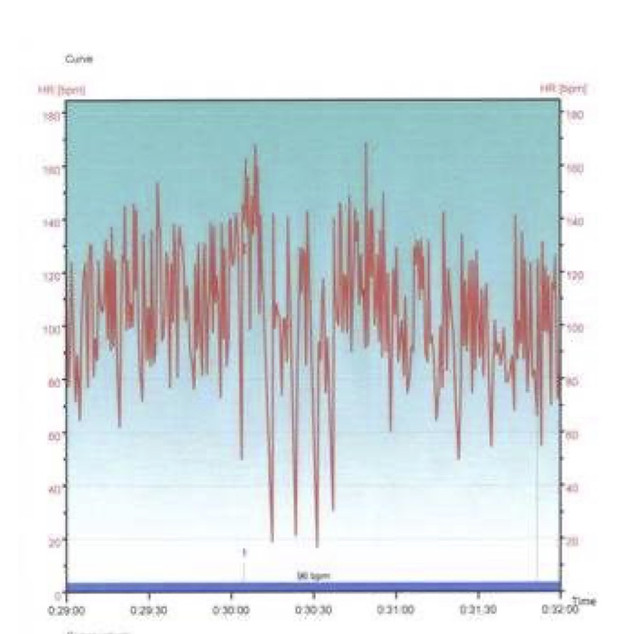
To illustrate Carey's point, here is an extreme example of NSR. Years ago, Mark, an optometrist from the UK sent me a PDF with a whole bunch of images of his unfortunate rhythms. NOTE, these are NOT ecg's, they are heart rate vs time graphs. EP's sometimes make them from Holter monitor data by plotting the time between R peaks in an ECG. This time can be converted to beats per minute and you get the same shape of the graph. This example (p32 of the PDF) is of Mark in NSR with many PAC's. The PAC beats, which are fast, are all followed by a slow compensatory beat. There are also some regular nsr beats. The second image (p14 of the PDF) is a zoom of what afib looks like.

Edited 2 time(s). Last edit at 11/01/2024 08:50PM by GeorgeN.
Edited 2 time(s). Last edit at 11/01/2024 08:50PM by GeorgeN.
|
Re: Accuracy of Kardia Mobile?? Frustrated! November 01, 2024 05:16PM |
Registered: 7 years ago Posts: 26 |
A big thank you to both of you!! You’ve restored my confidence in Kardia now knowing those close peaks is not z Afib.
I still need clarification why I got 3 different results of my Persistent Afib within 6 mins. But I’ll save it for my cardiologist as this thread is going longer than intended.
I also now know that if I can’t tap my foot to Atrial Fibrillation beats, I probably won’t be able to dance. 😊😊😊
Thanks again!!! 👍👍
I still need clarification why I got 3 different results of my Persistent Afib within 6 mins. But I’ll save it for my cardiologist as this thread is going longer than intended.
I also now know that if I can’t tap my foot to Atrial Fibrillation beats, I probably won’t be able to dance. 😊😊😊
Thanks again!!! 👍👍
|
Re: Accuracy of Kardia Mobile?? Frustrated! November 02, 2024 07:19AM |
Registered: 2 years ago Posts: 76 |
Quote
Carey
Do you know for a fact that you've ever been in afib with a HR below 50? Afib is a tachy-arrhythmia so bradycardia + afib would be quite unusual. I've never seen it before. It also seems unlikely that the designers would prioritize reporting something as obvious as bradycardia instead of afib, which is the device's primary purpose.
Hi Carey
In my case, I've had a low pulse in the 40's for about 40 years. Many doctors over the years used to comment that I must be very athletic but I was not. My afib was first diagnosed in 2012. But I only had my first afib "event" over 2 months ago when my pulse went up to 150 BPM and it took 2 days to get it down by medical cardioversion. I am now taking 17mg metropolol daily. Even when in afib, my resting pulse is usually below 50 though sometimes Kardia says I am bradycardia and sometimes it says possible afib. But for the bradycardia readings, when I look at the tracing, I am in afib.
I have no symptoms when in afib other than during the event just over 2 months ago when I felt my heart racing.
Attached is a bradycardia reading which I think shows I'm in AFIB. Do you agree?
|
Re: Accuracy of Kardia Mobile?? Frustrated! November 02, 2024 07:39AM |
Registered: 8 years ago Posts: 942 |
|
Re: Accuracy of Kardia Mobile?? Frustrated! November 02, 2024 01:10PM |
Admin Registered: 13 years ago Posts: 4,704 |
|
Re: Accuracy of Kardia Mobile?? Frustrated! November 02, 2024 01:28PM |
Registered: 7 years ago Posts: 26 |
My goodness, so much resemblance to my case. Below 50 HR, Drs saying low HR is good because I play competitive tennis, Afib episodes with HR still low,
an ablation many years after 1st diagnosis of AFib.. Wow. I’ve even had Drs saying low HR is saving beats for later in life when I need it. However, as I’m older I no longer exercise nearly as much as when I was even in my 40s and still have resting HR low 50s and in 40s. Scary to think what it must be when sleeping.
The Kardia readings of Brady, Unclassified, Possible Afib, and Nornal Sinus Rhythm are still a bit questionable to me. I wonder if Atrial Flutter may be throwing a hiccup in Kardia’s software? Have you ever been told you have Flutter? I bring this up because a PA once told me he saw a slight signs of Flutter in one of my Kardia Nornal readings.
I wish someone from Alivcore was monitoring this thread and would chim in.
Seeing a new Electrophysiologist today. Hope to have these questions answered ..
….to be continued
an ablation many years after 1st diagnosis of AFib.. Wow. I’ve even had Drs saying low HR is saving beats for later in life when I need it. However, as I’m older I no longer exercise nearly as much as when I was even in my 40s and still have resting HR low 50s and in 40s. Scary to think what it must be when sleeping.
The Kardia readings of Brady, Unclassified, Possible Afib, and Nornal Sinus Rhythm are still a bit questionable to me. I wonder if Atrial Flutter may be throwing a hiccup in Kardia’s software? Have you ever been told you have Flutter? I bring this up because a PA once told me he saw a slight signs of Flutter in one of my Kardia Nornal readings.
I wish someone from Alivcore was monitoring this thread and would chim in.
Seeing a new Electrophysiologist today. Hope to have these questions answered ..
….to be continued
|
Re: Accuracy of Kardia Mobile?? Frustrated! November 02, 2024 03:48PM |
Admin Registered: 9 years ago Posts: 6,247 |
|
Re: Accuracy of Kardia Mobile?? Frustrated! November 02, 2024 04:51PM |
Admin Registered: 13 years ago Posts: 4,704 |
Quote
Myticker
I’ve even had Drs saying low HR is saving beats for later in life when I need it. However, as I’m older I no longer exercise nearly as much as when I was even in my 40s and still have resting HR low 50s and in 40s. Scary to think what it must be when sleeping.
Chronic endurance exercise was my path to afib 20 years ago & my first four months of my afib career had a 2.5 month episode of persistent afib (terminated with a loading dose of the med flecainide). Exercise was a vagal or parasympathetic afib trigger for me. This means the afib didn't happen during exercise, but after, when resting or in the night while sleeping. I empirically learned I could do long duration activity without it being a trigger as long as I limited my exertion to what I could do using nasal breathing. Later, I learned the cycling community calls this "Zone 2." From a metabolic perspective you are using aerobic metabolism for almost all of your energy generation. I believe higher exertion, which utilizes more anaerobic (without oxygen) metabolism has much more oxidative stress. I also found that empirically, I could do short term high & even max effort activity without issue. Using these observations as guidelines, I've found ways to maintain excellent fitness at age 69 with a minimal afib burden (commonly below 0.05% in most years). My average heart rate last night during sleep was 45 and the low was 37.
A 3 year old thread on the exercise topic is a good read: [www.afibbers.org]
|
Re: Accuracy of Kardia Mobile?? Frustrated! November 03, 2024 05:43AM |
Registered: 2 years ago Posts: 76 |
Quote
Carey
What you see in that recording is a PVC. Again, afib isn't an odd beat here and there. It's a continuous arrhythmia. Flutter is the same. That recording does not show afib or flutter.
Thank you Carey for commenting. I value your views and if I do find an afib recording with < 50 BPM I will indeed post it.
Thanks also Pompon.
|
Re: Accuracy of Kardia Mobile?? Frustrated! November 03, 2024 05:56AM |
Registered: 2 years ago Posts: 76 |
Quote
GeorgeN
Chronic endurance exercise was my path to afib 20 years ago & my first four months of my afib career had a 2.5 month episode of persistent afib (terminated with a loading dose of the med flecainide). Exercise was a vagal or parasympathetic afib trigger for me. This means the afib didn't happen during exercise, but after, when resting or in the night while sleeping. I empirically learned I could do long duration activity without it being a trigger as long as I limited my exertion to what I could do using nasal breathing. Later, I learned the cycling community calls this "Zone 2." From a metabolic perspective you are using aerobic metabolism for almost all of your energy generation. I believe higher exertion, which utilizes more anaerobic (without oxygen) metabolism has much more oxidative stress. I also found that empirically, I could do short term high & even max effort activity without issue. Using these observations as guidelines, I've found ways to maintain excellent fitness at age 69 with a minimal afib burden (commonly below 0.05% in most years). My average heart rate last night during sleep was 45 and the low was 37.
A 3 year old thread on the exercise topic is a good read: [www.afibbers.org]
GeorgeN, I really appreciate your experience on exercise. I tried the nose only breathing tonight. I don't have the long baseline you have but am hopeful it will help me do more. In August I stopped doing 2 hrs moderate exercise (3-5 days weekly) after being let out of hospital. Am now slowing building it up. My spouse doesn't like me doing pushups but hopefully I can safely add that to 30 minutes of yoga and other stretches. My Kardia today reported NSR for the first time in ages. But if I go walking 3 miles my BP goes to around 110-135 BPM -- it comes down, sometimes in 20 minutes, sometimes in a couple of hours. My target, perhaps naive, is to get off the BBs and anti-coagulants...
I spent a bit of time on the links you sent. I need more time to review it. I noted that you have useful monitoring devices and a good "picture" of your afib.
Thanks again.
|
Re: Accuracy of Kardia Mobile?? Frustrated! November 03, 2024 06:08AM |
Registered: 2 years ago Posts: 76 |
Quote
Myticker
My goodness, so much resemblance to my case. Below 50 HR, Drs saying low HR is good because I play competitive tennis, Afib episodes with HR still low,
an ablation many years after 1st diagnosis of AFib.. Wow. I’ve even had Drs saying low HR is saving beats for later in life when I need it. However, as I’m older I no longer exercise nearly as much as when I was even in my 40s and still have resting HR low 50s and in 40s. Scary to think what it must be when sleeping.
The Kardia readings of Brady, Unclassified, Possible Afib, and Nornal Sinus Rhythm are still a bit questionable to me. I wonder if Atrial Flutter may be throwing a hiccup in Kardia’s software? Have you ever been told you have Flutter? I bring this up because a PA once told me he saw a slight signs of Flutter in one of my Kardia Nornal readings.
I wish someone from Alivcore was monitoring this thread and would chim in.
Seeing a new Electrophysiologist today. Hope to have these questions answered ..
….to be continued
Hi Myticker - nice to meet someone with a similar afib profile ! Yes, in 2019 flutter was mentioned on my holter report or ecg, I can't remember which. I think it is more challenging to treat both afib and flutter.
I am new to everything here and very much in a learning mode.
Sorry, only registered users may post in this forum.