Welcome to the Afibber’s Forum
Serving Afibbers worldwide since 1999
Moderated by Shannon and Carey
 |
 |
 |
 |
 |
 |

Home
>
AFIBBERS FORUM
>
Topic
Haywire Heart and Cycling Perspective
Posted by NotLyingAboutMyAfib
|
Haywire Heart and Cycling Perspective April 21, 2021 05:59PM |
Registered: 7 years ago Posts: 783 |
# 1 - Is this a good book?
[www.bigandtallbike.com]
Too much exercise can kill you. The Haywire Heart is the first book to examine heart conditions in athletes. Intended for anyone who competes in endurance sports like cycling, triathlon, running races of all distances, and cross-country skiing, The Haywire Heart presents the evidence that going too hard or too long can damage your heart forever.
# 2 - An interesting article
[www.velonews.com]
|
Re: Haywire Heart and Cycling Perspective April 21, 2021 06:38PM |
Admin Registered: 13 years ago Posts: 4,706 |
Zinn & I were going to talk in 2015 as I live ~30 minutes from him. He was early in his afib journey. Because of our schedules, it never happened. He did connect with EP John Mandrola to write the book (which I've not read). Mandrola, also a cyclist, got to experience afib personally. One tip I got from a Mandrola article years ago was to be quiet (i.e. inactive) after taking PIP flec to reduced the risk of flutter. I do this & have never taken a BB with my flec (I am not suggesting others do likewise).
Your link shows the book as out of stock. It is available on Amazon. For the endurance exercisers out there, just read the top Amazon comments. NLAMA already knows my position: exercise is wonderful, too much intensity times duration is not good for arrhythmia. Zone 2 is where it is at. This can be implemented using Phil Maffetone's MAF heart rate approach (link in this post). A new, experimental, way to determine if you are in this zone is with DFA Alpha 1. Marco Altini has implemented this in his Heart Rate Variability Logger App and explains it in this article. I've used this app since ~2014 to capture r to r (beat to beat) data from my Polar H10 strap (sometimes overnight). I export the data and create a file I can use with the old Polar Precision Performance Software to view, window and analyze the data. For examples of what you can see in these data, look here.
I use the upgraded app with DFA Alpha 1 to insure the bulk of my training (which is very varied: strength, isometrics, body weight, rings, suspension training, rowing, bike, skier, jump rope all with & without KAATSU BFR bands) is Zone 2. For a reasonable approximation - just always breathe through your nose.
Edited 5 time(s). Last edit at 04/21/2021 07:34PM by GeorgeN.
|
Re: Haywire Heart and Cycling Perspective April 21, 2021 07:18PM |
Registered: 12 years ago Posts: 3,078 |
Quote
GeorgeN
One tip I got from a Mandrola article years ago was to be quiet (i.e. inactive) after taking PIP flec to reduced the risk of flutter. I Zinn & I were going to talk in 2015 as I live ~30 minutes from him. He was early in his afib journey. Because of our schedules, it never happened. He did connect with EP John Mandrola to write the book (which I've not read). Mandrola, also a cyclist, got to experience afib personally. .
Wow wow wow. This was never discussed in this forum in connection of taking a pip. Now I feel like a bigger idiot.
1. I didn’t know when trying the 300mg flecainide pip the dosing dangers if one weighed less than 154 pounds. I weighed 121.
2. The above flutter connection if one exercises after the pip. I was instructed to go on a treadmill after my high flecainide dosage while hooked up with the ep supervision in his office exam room. No wonder I immediately had a huge tachycardia!
IMHO #1-2 should be mentioned in ALL future PIP discussions to avoid another person wrecking their heart, getting a flecainide overdose and spending 3 days fighting not to die in the icu. Just saying....
Is there a #3 advice yet mentioned that would benefit those thinking of a PIP experiment? Nows the time to contain it in this thread for future reference.
|
Re: Haywire Heart and Cycling Perspective April 22, 2021 02:09AM |
Admin Registered: 13 years ago Posts: 4,706 |
Quote
NotLyingAboutMyAfib
# 1 - Is this a good book?
[www.bigandtallbike.com]
Too much exercise can kill you. The Haywire Heart is the first book to examine heart conditions in athletes. Intended for anyone who competes in endurance sports like cycling, triathlon, running races of all distances, and cross-country skiing, The Haywire Heart presents the evidence that going too hard or too long can damage your heart forever.
I've read about 25% and it is a good book so far.
|
Re: Haywire Heart and Cycling Perspective April 22, 2021 07:12AM |
Registered: 8 years ago Posts: 942 |
I know that "too much exercise" can be bad.
The fact is we're not equal and "too much" for one may be "nearly negligible" for the other.
So, "too much" can obviously damage the heart (as often described) and lead to arrhythmias.
OTOH, "too much" can be far from what is usually described as "excessive". In my case, the only obvious effect years of "active" life and moderate exercise have had on my heart was bradycardia at rest (~50 BPM). And this (supposedly combined with genetics) has led me to AFib.
Since ablation (and "detraining"), my HR at rest is about 10 beats higher than before. As a result, the "threshold" for ectopics at rest (and AFib) has been raised at 60 BPM. Too bad.
|
Re: Haywire Heart and Cycling Perspective April 22, 2021 02:20PM |
Registered: 7 years ago Posts: 783 |
I bought the book shortly after making the post. George - as always, thank you for your thoroughness and well thought out solutions.
I am already a believer in your philosophy and will refine based on your notes above.
I'm not sure if 'too much' exercise is a problem but I definitely believe that 'too intense for too long' is a problem. It's very hard to admit that now. I trained and raced really hard to over come my genetics as no one would look at me and say "that 6'4" guy that weighs 180 lbs should be a cyclist".
Cycling was my 2nd choice sport as I was on track to make the 1980 Olympics as a swimmer but the boycott wrecked those plans. Swimming is far less damaging in my layman's view but perhaps after reading the book I'll have a different perspective.
My generation (late baby boomer) were fed a load of BS (cholesterol, carbs) that is largely responsible for the health issues we see today.
If I had to weigh the causes of my afib (never found a trigger) - it would be 40% lifestyle neglect from age 40-55, 40% former athletic pursuits, 10% genetics and 10% unknown or multifactorial (events leading up to 1st afib event).
Once I was persistent, I had to face up to the fact that my AFIB cards were already dealt.
My hopes for the book (arrives tomorrow) is that it will give me a better understanding of what factors are in play and while I had ambitions a few years ago about setting an age class record in the hour, my heart will no longer support those dreams and my focus is just general health and well being and avoiding any more procedures.
|
Re: Haywire Heart and Cycling Perspective April 22, 2021 08:21PM |
Admin Registered: 13 years ago Posts: 4,706 |
Quote
Pompon
I know that "too much exercise" can be bad.
The fact is we're not equal and "too much" for one may be "nearly negligible" for the other.
So, "too much" can obviously damage the heart (as often described) and lead to arrhythmias.
OTOH, "too much" can be far from what is usually described as "excessive". In my case, the only obvious effect years of "active" life and moderate exercise have had on my heart was bradycardia at rest (~50 BPM). And this (supposedly combined with genetics) has led me to AFib.
.
Clearly, there is a lot of variability. There are those who are chronically fit for life and never get afib (likely the majority). On one end of getting afib is:
SourceQuote
splashrollandplod
Hi, I am 65 and I do triathlons (73 and counting) I’ve had symptomatic AF once 21 months ago - during a triathlon in Russia!
On the other end is my 35 year old son-in-law. He's in the military, so required to be fit. Has run some half marathons, but not fanatical and presented with afib at age 30.
From the preface to the Haywire Heart book: "The sun shone bright on the upturned Flatirons rock formations above Boulder, Colorado. It was another perfect day in a cycling paradise. Lennard Zinn, a world-renowned technical cycling guru, founder of Zinn Cycles, author of Zinn and the Art of Road Bike Maintenance, longtime member of the VeloNews magazine staff, and former member of the US national cycling team, was riding hard up his beloved Flagstaff Mountain, a popular road that snakes over 4 miles and almost 2,000 feet above the city. It was a ride he had done a thousand times before. But on this day, in July 2013, his life would change forever. Fifteen minutes into his attempt to set a new Strava “king of the mountain” (KOM) time for the climb in the 55-plus age group, he felt his heart “skip” a beat. It was something he had felt before, but only at rest. He looked down at the Garmin computer on his handlebars and noticed that his heart rate had jumped from 155 to 218 beats per minute (bpm) and stayed elevated. He tapped the Garmin’s screen. Was the connection bad? He felt fine but eventually pulled the plug on the attempt, knowing that the distraction had disrupted any chance at a record. His heart rate immediately dropped, so he headed down the mountain to establish a different Strava segment KOM. His training plan called for a very hard ride, so he went to another climb and did a set of intervals. His ride completed, he headed home."
Case Christopher J.; Mandrola Dr. John; Zinn Lennard. The Haywire Heart: How too much exercise can kill you, and what you can do to protect your heart . VeloPress. Kindle Edition.
I was someplace in the middle. I'd always been fit, but not obsessive, and around the age of 41 decided to enter the Pikes Peak Ascent race (gains 7,800' over 13 1/3 miles topping out at 14,100'). I just wanted to finish, not compete to win anything. At age 49, after a training run for this race on a 14,000' peak, I had my first episode. I'd been competing annually.
What I know, in retrospect, is how much stress I was putting on my system. Years before I ever entered these races, my resting heart rate was easily in the low 40's. When I would finish a race, my resting heart rate would remain materially elevated for several days, then drop below normal and then finally returning to normal. After I had my first afib episode and before I decided to detrain and not compete, the period of below normal resting heart rate was a risk period for me.
After deciding that detraining needed to be part of my afib remission plan, I learned that for me, the product of intensity times time was a trigger (short, high intensity, i.e. Tabatas, OK, long, low intensity OK, long high intensity, not OK). I'd been exposed to the work of John Douillard in the 90's & his book.. Unfortunately, I had not followed his nasal breathing prescription when first exposed. However, I decided it was a decent place to start with detraining. For me, it worked. Later, I became aware of Patrick McKeown's breathing work. It was Patrick's work that convinced me to tape my mouth during sleep.
This detraining, along with electrolytes (magnesium to bowel tolerance, 4 g [2 tsp] of potassium as citrate in a liter of water consumed over the day & 2 g [1/2 tsp] taurine powder, and later, avoiding excess calcium in my diet) has allowed me to remain in relative afib remission for 16 1/2 years after an initial 2 1/2 month episode. [if you don't have good kidney function, don't play with electrolytes without medical supervision].
When I began helping my son-in-law with his afib, I wanted to quantify my detraining. It was then that I learned of Zone 2 as well as the MAF approach. In the Iñigo San Milán interview on Z2, I learned that training at this modest intensity can increase mitochondrial density up to 4x as well as increasing mitochondrial size. My friend, Dr. Mark Cucuzzella is a doc and runner who has been training using the MAF method for about 20 years. Mark calls his training "loafing." He says he always wants to end a run feeling better than when he started - i.e. more energy, not wiped out. In studying more about Z2, it turns out that most high end endurance athletes spend 80% of their training time in Z2 (now their Z2 may be higher than my maximum). Many recreational athletes spend most of their training time in more intense zones. Hence they never get the mitochondrial adaptation and likely incur much more stress.
My hypothesis is that if most recreational athletes spent most of their training time in Z2, we'd see much less afib in the group. Now once someone has afib, even Z2 may be too intense for some. All bets are off.
I have a friend who immigrated to the US from Morocco. He's a Berber (basically peasants living in rural villages). His village was around 30 miles from Marketch, in the foothills of the Atlas Mountains. His now 80+ year old father herded goats. He would leave early in the morning with the goats and follow them all day, up and down the steep hills and valleys, returning in the evening. T2 diabetes is rampant in his father's family. But his dad remains healthy do this day. An anecdote of spending the day being active, but not doing anything excessive. His father's goatherd friend, who was ~15 years older, was well and healthy till the day he passed. A testament to the lifestyle.
In the book, Dr. Mandrola does a good job of describing how folks with metabolic illness and the athletes with excessive training can end up with the same atrial substrate issues that allow afib to be sustained.
|
Re: Haywire Heart and Cycling Perspective April 23, 2021 08:48AM |
Registered: 8 years ago Posts: 942 |
Thanks, George.
It seems obvious I did "too much", relatively to the amount that was already enough for me.
I didn't know both my parents were afibbers. They even didn't know themselves! In their cases, it'd been diagnosed after a stroke. They were active, but nothing like athletes.
Both my sisters are active too (one is walking, the other one bicycling), but at a more modest level than mine (which is already modest), and the're fine to date.
I'm now bicycling and walking at a more reasonable pace for a long time, but this "detraining" hasn't change anything to date for me.
|
Re: Haywire Heart and Cycling Perspective April 23, 2021 04:45PM |
Registered: 7 years ago Posts: 783 |
I am kind of thankful I no longer have any cycling friends. Practically every ride I've ever been on was either to punish others or have them punish me. I still have to constantly remind myself when someone faster than me goes by. "it's not big deal... relax... stick to your plan". When I used to race or train hard, I'd keep my heart rate between 188 and 192. Today it's 120 to 130 although MAF dictates it should be lower.
[philmaffetone.com] (Thanks George!)
[philmaffetone.com] (Thanks George!)
|
Re: Haywire Heart and Cycling Perspective April 23, 2021 08:59PM |
Admin Registered: 13 years ago Posts: 4,706 |
Quote
Pompon
I didn't know both my parents were afibbers. They even didn't know themselves! In their cases, it'd been diagnosed after a stroke. They were active, but nothing like athletes.
My father was one of the least active people I've known. To my knowledge, he never had afib. Both of his brothers did, however. They had obesity and not very active. Onset was later in age, so likely caused by comorbidities. My mother had dementia, and I would walk her daily. In her mid 80's, I discovered afib in her radial pulse in the middle of a walk. When we got back to her room, she had reverted to NSR. I then caught this on a monitor, but her doctor & I decided not to do anything about it. She'd been a modest walker.
Quote
Pompon
Both my sisters are active too (one is walking, the other one bicycling), but at a more modest level than mine (which is already modest), and they're fine to date.
In the book, Dr. Mandrola quotes a study saying walkers are the least likely to get afib. He also notes that for those who are inactive and have metabolic illness, adding activity to a modest level can be very beneficial for their afib and reduce it.
Quote
NotLyingAboutMyAfib
I am kind of thankful I no longer have any cycling friends. Practically every ride I've ever been on was either to punish others or have them punish me. I still have to constantly remind myself when someone faster than me goes by. "it's not big deal... relax... stick to your plan". When I used to race or train hard, I'd keep my heart rate between 188 and 192. Today it's 120 to 130 although MAF dictates it should be lower.
I mentioned Dr. John Douillard's nasal breathing approach above. When I tried it, I could not stand going so slow, so never took the time to adapt, which is where the "magic" is. Even after limiting my exertion to this level, I did not learn about the mitochondrial benefit to training at this level. Today, I can ski aggressively off pisté at 12 or 13,000' and always breathe through my nose. I still have to watch my competitive nature. Before getting ill, my son was a big Crossfitter. I always declined his invites to join him as I knew my competitive instincts would turn on, which would not be good for my afib. Also, my wife & I were skiing this year. She doesn't do anything but groomed runs because of foot and hip pain. So I'd always find nice runs for us, but had a hard time keeping myself from skiing at higher speeds (like 65 MPH). It wasn't really an afib issue, but I do have to ask myself why I feel I need to do this.
My MAF HR is 115 and using feedback from the DFA (Alpha 1), my max level is more like 112. I never thought I could do reasonable workouts at these levels, but I do and am now quite satisfied.
Edited 1 time(s). Last edit at 05/03/2021 01:39AM by GeorgeN.
|
Re: Haywire Heart and Cycling Perspective April 24, 2021 06:29AM |
Registered: 8 years ago Posts: 942 |
This is a sad thing learning that what you thought being healthy habits are bad for you.
Then, you talk about that with your friends and family, and they are amazed, for they condidered you were a healthy guy. And then, they say : Wow ! There's no hurry for me to start exercising. I'm fine with my above average BMI.
Then, you talk about that with your friends and family, and they are amazed, for they condidered you were a healthy guy. And then, they say : Wow ! There's no hurry for me to start exercising. I'm fine with my above average BMI.
|
Re: Haywire Heart and Cycling Perspective April 24, 2021 04:16PM |
Registered: 8 years ago Posts: 712 |
Quote
NotLyingAboutMyAfib
I am kind of thankful I no longer have any cycling friends. Practically every ride I've ever been on was either to punish others or have them punish me. I still have to constantly remind myself when someone faster than me goes by. "it's not big deal... relax... stick to your plan". When I used to race or train hard, I'd keep my heart rate between 188 and 192. Today it's 120 to 130 although MAF dictates it should be lower.
[philmaffetone.com] (Thanks George!)
Ditto. Almost all my cycling is solo these days. I ride when I want. Where I want. As fast and hard as I want. And if I don't want to go I don't feel obligated. I have a couple people I still ride with and we aren't out to out do each other. Absolutely no reindeer games. Same goes for my XC skiing.
|
Re: Haywire Heart and Cycling Perspective April 28, 2021 08:46PM |
Registered: 8 years ago Posts: 712 |
|
Re: Haywire Heart and Cycling Perspective May 03, 2021 02:00AM |
Admin Registered: 13 years ago Posts: 4,706 |
Quote
rocketritch
I really need to dig into your information George. Where I live and ride it's impossible to remain in zone 2. I'm also not sure I'm entirely understanding your detraining concept.
Rich, this has been a journey. I'm still a 65 year old guy with the frontal lobe of an 18 year old... (I had to argue with myself for two years to stop competing) Early on, for me, I determined that if I got my electrolytes right then I could do about what I wanted as long as substantial duration exercise was at what turns out is about Z2/MAF/nasal breathing as a limit. I mentioned John Douillard's nasal breathing approach from the 90's. I had your feeling of I can't do this as I'd have to stop and walk up that hill to keep nasal breathing. Hence I didn't do it in the 90's, though I now think that if I had, I may never have gotten afib.
Douillard did some studies and after folks adapted they could to the same or more work at much lower heart and breath rates. Only problem is that adaptations can take months. For a long time, I thought Douillard's adaptations were increasing CO2 tolerance for nasal breathing. Now, listening to and reading San Milán's work, I'm guessing a big part of the adaptation was mitochondrial density increase. For many years, I just knew I need to limit myself to these rates (on long duration exercise- short, like Tabatas or alactic intervals were OK - it was the product of intensity times distance that was my trigger). What I now understand is that intentionally training at these levels can have benefits such as the increased mitochondrial density.
At the time Mark Cucuzzella wrote this blog: [naturalrunningcenter.com] he'd been training per Maffetone's approach (essentially Z2) since 2000. Mark was 50. So his MAF heart rate would have been 180-50 =130.
What you can see from his results - all hooked with a mask on a treadmill with lab equipment is his AeT or fat burning threshold heart rate was 166
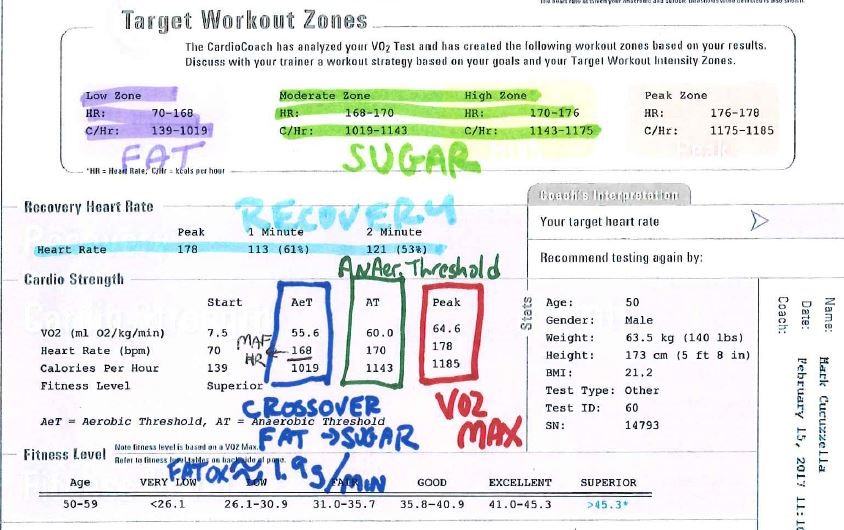
The MAF heart rate (180-age) predicts the AeT HR. The year before data are also shown in the blog and it is much closer.
Mark's adaptation means he can almost go full out for an unlimited period of time, as he's still burning fat. What he told me is when he trains, he's "loafing." He's also run 30 marathons under 3 hours. He also says, whenever he goes out, he wants to come back feeling refreshed, not wiped out.
I think the point is many (including me) felt you had to work really hard to improve your system. However the magic is quite the opposite and the pro trainers (like Tour de France) know this and keep their guys in Z2 most of the time.
My objective is not to win any races, just stay as healthy as I can so I can be active till I drop dead one day. As Ken Cooper MD of Aerobics fame says (he's 90), he wants to "square the curve."
Edited 1 time(s). Last edit at 05/12/2021 10:02PM by GeorgeN.
|
Re: Haywire Heart and Cycling Perspective May 12, 2021 07:19PM |
Registered: 7 years ago Posts: 783 |
I can't name names but I used to ride with several national champions, world champions, world record holders and olympic medalists. One of these friends (to identify his leading palmarès would identify him) and I were out on a 90 mile ride one day. We both had HRMs on and despite having always assumed we were somewhat equal in HR, I bothered to ask him where he was. We'd been riding side by side with no wind issues and at the same speed he was a full 30 BPM lower than me. We discussed further and he time trialed a full 20 BPM lower than me. More efficient pedaling was what I assumed at the time but he was also more efficient in the way he burned fuel and as it turns out the fuel of choice - fat. We're seeing this more and more these days. Winners are fat fueled vs carb fueled. [ultrarunning.com]
|
Re: Haywire Heart and Cycling Perspective May 13, 2021 06:25AM |
Registered: 8 years ago Posts: 942 |
Champions have a lower HR than average. They can deliver more power than average for the same HR.
OTH, one can't burn fat at high intensity exercise. Our body needs time to convert fat to sugar, and it can't do that while exercising, unless we exercise at a quiet level. Hoping to burn fat with exercise is often counter productive.
Then, our metabolism behaves at its own pace. We're all different. I'm in the "skinny" league. I can't get fat, whatever I eat. In 5 years dealing with AFib, I've detrained a lot (from 6 to 7000 km/ year riding my bicycle to barely 1000 km). And I've lost weight. The only way to get back to my "normal" weight is re-training to increase my muscular mass.
|
Re: Haywire Heart and Cycling Perspective September 16, 2021 08:54PM |
Registered: 8 years ago Posts: 20 |
Sorry, only registered users may post in this forum.
Parse error: syntax error, unexpected token "{" in /services/webpages/a/f/afibbers.org/public/forum/mods/spamhurdles/api.php on line 694